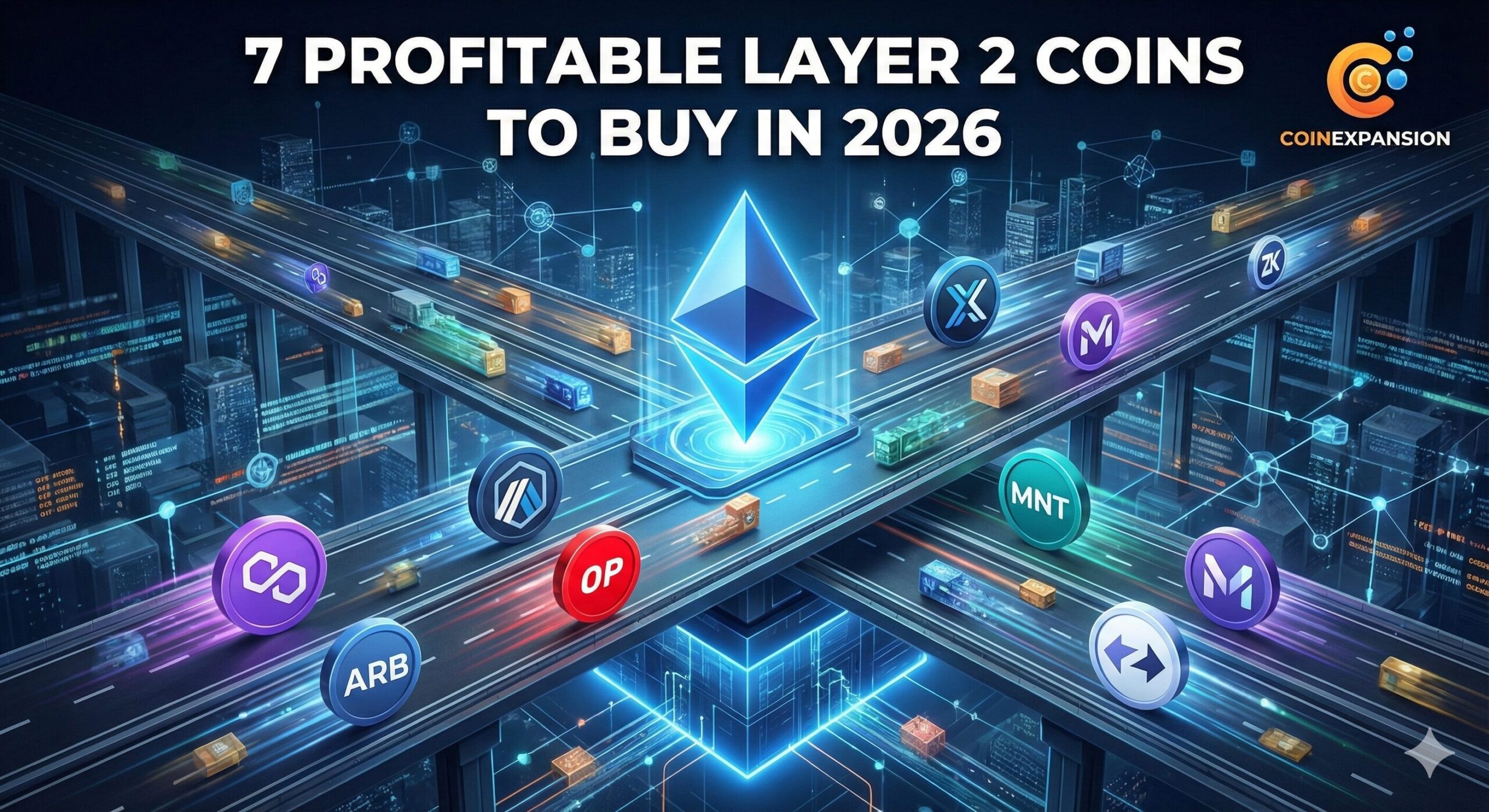
7 Profitable Layer 2 Coins to Buy in 2026 (Ethereum’s Scalability Engines)
If you have ever tried to use Ethereum during a bull run, you know the pain. You go to buy a $50 NFT, and the gas fee is $100. It’s ridiculous. That is why the “Smart Money” has stopped betting on Ethereum alone and started betting on the “Highways” built on top of it. We call these profitable layer 2 coins.
In 2026, Layer 2s (L2s) aren’t just “side projects” anymore; they are the main event. Ethereum has effectively become the “settlement layer” (like the bedrock), while L2s are where all the trading, gaming, and fun actually happens. Investing in L2s is like investing in the toll booths on the busiest highway in the world.
I have analyzed the Total Value Locked (TVL), the developer activity, and the institutional adoption to find the specific networks that are generating real revenue. If you want to build a portfolio that captures the growth of Web3 without paying $50 for a transaction, these are the profitable layer 2 coins you need to watch.
Key Takeaways
- The “Toll Booth” Thesis: Layer 2s generate revenue by bundling thousands of transactions and settling them cheaply on Ethereum. You profit by owning the token that governs this cash flow.
- Narratives to Watch: In 2026, the battle is between Optimistic Rollups (Arbitrum, Optimism) and ZK-Rollups (ZKsync, Starknet).
- The Gaming Niche: Coins like Immutable (IMX) are specifically designed for gaming, making them potentially more profitable layer 2 coins than general-purpose chains.
- Top Pick: Arbitrum (ARB) remains the DeFi king, but Polygon (POL) has the most ambitious roadmap with its “AggLayer.”
1. Polygon (POL)
- Current Price (Est. 2026): ~$0.95
- Risk Level: Low-Medium
- 2026 Catalyst: The AggLayer & ZK Migration
- Best For: Institutional Adoption
Formerly MATIC, Polygon has rebranded to POL to power its “AggLayer” (Aggregation Layer).1 Think of it as a spiderweb that connects all blockchains together, making them feel like one single chain. It is already the preferred partner for Nike, Starbucks, and Reddit.
Why it will be profitable:
Polygon isn’t just one chain; it’s an ecosystem of chains.2 With the full launch of the AggLayer in 2026, POL becomes the hyper-productive token that secures this entire network. As liquidity flows freely between chains, POL captures the value.3 It is widely considered one of the most profitable layer 2 coins because it has solved the problem of “fragmented liquidity.”
Price Prediction Model (2026–2030)
We value POL based on “Network Utility.”
| Year | Low Forecast | High Forecast | Reasoning |
| 2026 | $1.50 | $2.20 | AggLayer connects massive liquidity; institutional usage spikes. |
| 2027 | $2.80 | $3.50 | ZK-Rollup tech matures, reducing costs further. |
| 2028 | $4.50 | $6.00 | Polygon becomes the backend for major Web2 consumer apps. |
| 2030 | $8.00 | $12.00 | A top 5 global infrastructure asset. |
2. Arbitrum (ARB)
- Current Price (Est. 2026): ~$1.80
- Risk Level: Low-Medium
- 2026 Catalyst: Arbitrum Stylus & Orbit Chains4
- Best For: DeFi Power Users
Arbitrum is the king of DeFi (Decentralized Finance). It holds the most “Total Value Locked” of any Layer 2.5 In 2026, their “Stylus” upgrade allows developers to write smart contracts in standard languages like C++ and Rust, not just Solidity.6 This opens the door for millions of non-crypto developers to build on Arbitrum.
Why it will be profitable:
Adoption follows liquidity. Traders prefer Arbitrum because it is where the money is. The ARB token governs the Arbitrum DAO, which is one of the richest in crypto. As they launch “Orbit Chains” (custom chains for specific apps), value flows back to the main Arbitrum ecosystem, solidifying ARB’s status as one of the most profitable layer 2 coins.
Price Prediction Model (2026–2030)
Valued based on “TVL Dominance.”
| Year | Low Forecast | High Forecast | Reasoning |
| 2026 | $2.50 | $3.80 | Stylus upgrade attracts Web2 developers to Web3. |
| 2027 | $4.50 | $6.00 | DeFi market cap expansion drives demand for ARB governance. |
| 2028 | $7.50 | $10.00 | Arbitrum Orbit chains become standard for enterprise DeFi. |
| 2030 | $15.00 | $22.00 | The primary execution layer for Ethereum finance. |
3. Optimism (OP)
- Current Price (Est. 2026): ~$2.50
- Risk Level: Medium
- 2026 Catalyst: The Superchain Thesis
- Best For: Ecosystem Bettors
Optimism isn’t trying to be a single blockchain; it is building a “Superchain.” This is a network of many different chains (like Base, Zora, and Worldcoin) that all share the same software stack. They share revenue with the Optimism Collective.
Why it will be profitable:
You are betting on the “OP Stack.” Even though Coinbase’s Base chain doesn’t have a token, it is built on OP technology, and a portion of its revenue goes back to the Optimism Collective. By holding OP, you are indirectly profiting from the success of every chain in the Superchain network. This unique revenue-sharing model makes OP one of the most strategically profitable layer 2 coins.
Price Prediction Model (2026–2030)
Valued based on “Superchain Revenue.”
| Year | Low Forecast | High Forecast | Reasoning |
| 2026 | $3.50 | $5.00 | 50+ chains join the Superchain ecosystem. |
| 2027 | $6.00 | $8.50 | Revenue sharing from Base and Worldcoin scales up. |
| 2028 | $10.00 | $14.00 | OP Stack becomes the “Android” of blockchain development. |
| 2030 | $18.00 | $25.00 | A massive, interconnected economy of chains. |
4. Immutable (IMX)
- Current Price (Est. 2026): ~$3.50
- Risk Level: Medium-High
- 2026 Catalyst: Mainstream Game Launches
- Best For: Gamers & NFT Traders
Immutable is a Layer 2 specifically built for gaming.7 It uses ZK-rollups to make minting NFTs carbon-neutral and gas-free.8 Major games like Gods Unchained and Guild of Guardians run on it.9
Why it will be profitable:
Gamers hate gas fees. Immutable solves this completely. As the “Passport” wallet feature removes friction for non-crypto natives, millions of players will onboard without even knowing they are using blockchain. If you believe gaming will onboard the next billion users, IMX is one of the most profitable layer 2 coins to hold.
Price Prediction Model (2026–2030)
Valued based on “Gaming Volume.”
| Year | Low Forecast | High Forecast | Reasoning |
| 2026 | $4.20 | $6.00 | Major AAA game title launch brings 1M+ daily users. |
| 2027 | $7.50 | $10.00 | zkEVM rollup captures massive NFT market share. |
| 2028 | $12.00 | $18.00 | Platform fees burned reduce IMX supply significantly. |
| 2030 | $25.00 | $35.00 | The “Steam” of Web3 gaming. |
5. Mantle (MNT)
- Current Price (Est. 2026): ~$1.20
- Risk Level: Medium
- 2026 Catalyst: Massive DAO Treasury & Yield10
- Best For: Yield Hunters
Mantle is unique because it has one of the largest treasuries in the entire crypto space (billions of dollars). It is a modular Layer 2 that separates execution, consensus, and data availability to be incredibly fast and cheap.
Why it will be profitable:
Money talks. Mantle uses its massive treasury to fund development and incentivize users with high yields. It is essentially a “Rich L2” that can afford to buy growth. This financial muscle positions MNT as a dark horse candidate for the list of profitable layer 2 coins in 2026.
Price Prediction Model (2026–2030)
Valued based on “Treasury Deployment.”
| Year | Low Forecast | High Forecast | Reasoning |
| 2026 | $1.80 | $2.50 | Treasury grants attract top-tier DeFi protocols. |
| 2027 | $3.00 | $4.50 | “mETH” (Mantle Staked ETH) adoption surges. |
| 2028 | $5.50 | $7.50 | Modular architecture proves superior for high-throughput apps. |
| 2030 | $10.00 | $14.00 | A top contender in the modular blockchain space. |
6. Metis (METIS)
- Current Price (Est. 2026): ~$70.00
- Risk Level: High
- 2026 Catalyst: Decentralized Sequencer
- Best For: Decentralization Purists
Most Layer 2s are actually centralized (a single company runs the “sequencer” that orders transactions). Metis is different; it was one of the first to decentralize its sequencer. This means the community actually runs the network, not just a corporation.
Why it will be profitable:
As regulators crack down on centralized L2s in 2026, Metis’s decentralized approach acts as a shield. It also offers generous staking rewards for those who secure the network. For investors who value censorship resistance, Metis is one of the most ethically and financially profitable layer 2 coins.
Price Prediction Model (2026–2030)
Valued based on “Staking Revenue.”
| Year | Low Forecast | High Forecast | Reasoning |
| 2026 | $90.00 | $130.00 | Decentralized sequencer narrative gains regulatory favor. |
| 2027 | $150.00 | $220.00 | Revenue sharing model attracts massive retail staking. |
| 2028 | $280.00 | $350.00 | Integration with Hybrid Rollup technology. |
| 2030 | $500.00 | $700.00 | A dominant, community-owned L2 economy. |
7. ZKsync (ZK)
- Current Price (Est. 2026): ~$0.35
- Risk Level: Medium-High
- 2026 Catalyst: Account Abstraction
- Best For: Tech Enthusiasts
ZKsync uses “Zero-Knowledge” proofs, which is the holy grail of scaling.11 It allows for “Account Abstraction,” meaning you can log in with FaceID or email instead of a complicated wallet. It makes crypto feel like a normal app.
Why it will be profitable:
User experience (UX) wins. ZKsync makes crypto invisible. In 2026, apps built on ZKsync are easier to use than competitors, driving mass adoption. While newer than Arbitrum, its tech is theoretically superior, making ZK one of the most technically promising profitable layer 2 coins.
Price Prediction Model (2026–2030)
Valued based on “Active User Wallets.”
| Year | Low Forecast | High Forecast | Reasoning |
| 2026 | $0.60 | $0.90 | Account Abstraction drives millions of non-crypto users. |
| 2027 | $1.20 | $1.80 | “Hyperchains” (L3s) launch on top of ZKsync. |
| 2028 | $2.50 | $3.50 | ZK tech becomes cheaper and faster than Optimistic rollups. |
| 2030 | $5.00 | $8.00 | The standard for consumer-facing crypto apps. |
Conclusion: The Layer 2 Supercycle
The “L2 Wars” are the defining story of the 2026 crypto market. We aren’t just speculating anymore; we are looking for cash flow and users.
My strategy? I treat Arbitrum (ARB) and Polygon (POL) as my “Blue Chips”—they are safe, established, and hold the most value. I use Optimism (OP) as my index fund for the broader ecosystem. And I allocate a smaller portion to Immutable (IMX) and ZKsync (ZK) for high-growth potential in gaming and tech. By building a basket of these profitable layer 2 coins, you are effectively betting on the success of Ethereum itself, but with much higher upside.
Frequently Asked Questions (FAQ)
Q: Why isn’t Base on this list of profitable layer 2 coins?
A: Base is an incredibly successful Layer 2 built by Coinbase, but it currently has no token. If you want to invest in the success of Base, the best way right now is to buy Optimism (OP), as Base is built on the OP Stack and shares revenue with the Optimism Collective.
Q: Are Layer 2 coins safer than Layer 1s like Solana?
A: They have different risk profiles. L2s rely on Ethereum’s security, which is very high.12 However, they can have their own bugs or centralization risks. Generally, profitable layer 2 coins like Arbitrum or Polygon are considered “safer” than newer, unproven Layer 1 blockchains.
Q: Can Layer 2 coins do a 100x?
A: It is harder for established coins like Polygon or Arbitrum to do a 100x because their market caps are already billions of dollars. However, newer or smaller cap L2s (like Metis or unreleased projects) have that explosive potential, though with much higher risk.
Q: What is the difference between Optimistic and ZK Rollups?
A: Optimistic rollups (Arbitrum, Optimism) assume transactions are valid unless proven otherwise (innocent until proven guilty).13 ZK rollups (ZKsync, Starknet) use math to prove transactions are valid instantly (verified truth). ZK is considered the “end game” tech, but Optimistic is currently more battle-tested.