The Ultimate Guide to the Difference Between Crypto Coins and Tokens (2026 Update)
You know, the first time I bought cryptocurrency, I made a mistake that still makes me laugh. I tried to send some USDT (a token) directly to a Bitcoin address (a coin). I stared at my screen for hours, sweating bullets, wondering why the money hadn’t arrived. I didn’t realize that I was trying to fit a square peg into a round hole. I was treating everything like “Bitcoin,” but the digital asset world is actually split into two very different families.
Understanding the difference between crypto coins and tokens is the most critical concept you need to learn if you want to survive in Web3. If you don’t know the difference, you risk losing funds, paying higher fees than necessary, or investing in projects you don’t actually understand. It sounds technical, but it’s actually quite simple once you see the “Landlord vs. Tenant” analogy.
So, grab a coffee, and let’s strip away the jargon. We are going to look at exactly what you are holding in your wallet, why it matters, and I’m going to give you a massive list of examples so you never get confused again.
Key Takeaways
- The “Landlord” Rule: A Coin has its own blockchain (like owning a house). A Token lives on someone else’s blockchain (like renting a room).
- Gas Fees Matter: You almost always pay transaction fees using the native Coin. You generally cannot pay gas fees with a Token, which is a common trap for beginners.
- Variety: Tokens are far more diverse. They can represent art (NFTs), voting rights (Governance), real-world dollars (Stablecoins), or even your digital identity (Soulbound).
- The 2026 Trend: The biggest shift this year is the rise of Real World Assets (RWAs)—tokens that represent ownership of physical things like gold or real estate.
The Core Technical Difference Between Crypto Coins and Tokens
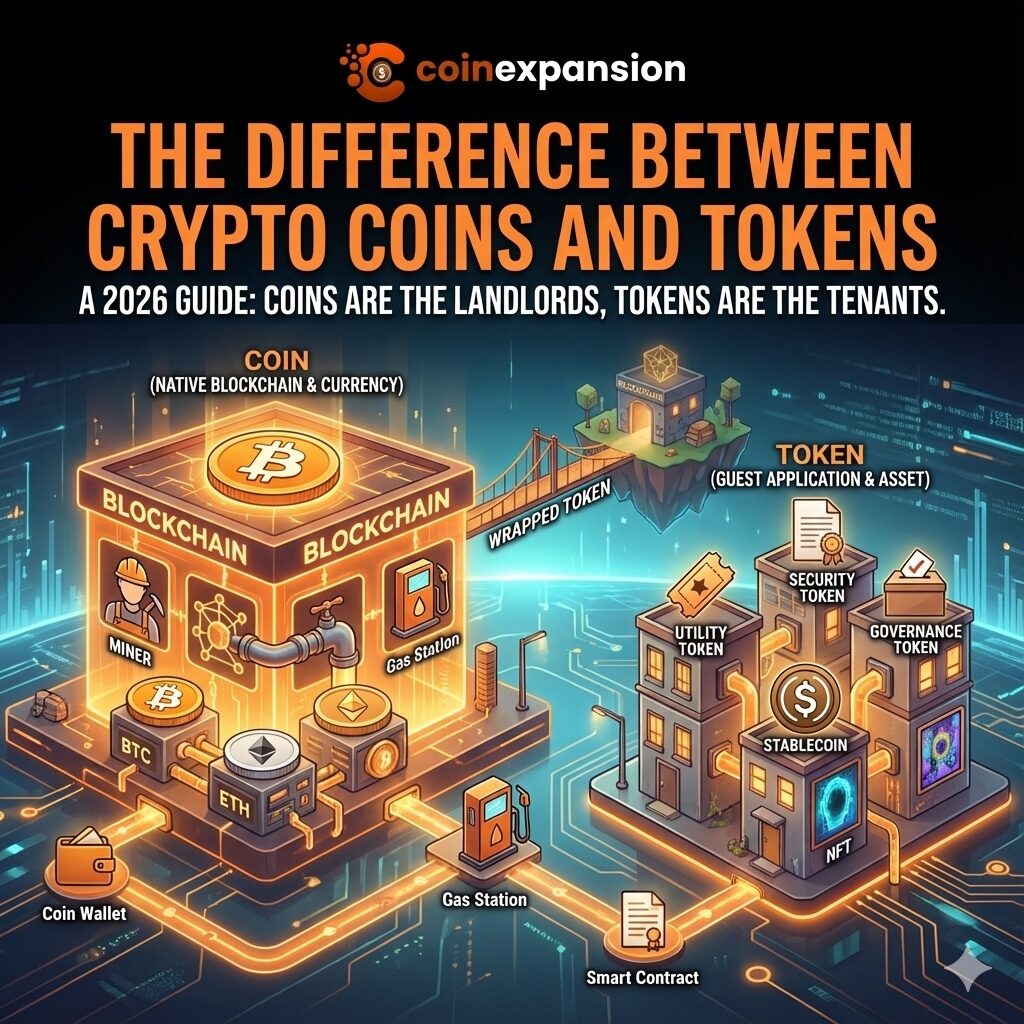
To really grasp the difference between crypto coins and tokens, we need to step away from computers for a second and look at real estate. Imagine a giant apartment building.
The building itself is the Blockchain. The owner of the building, who maintains the pipes, the electricity, the foundation, and the security, is the Coin (like Ethereum, Solana, or Bitcoin). They own the infrastructure.
Now, imagine people living inside that building. They don’t own the foundation; they just use the space to run their businesses, store their furniture, or live their lives. These are the Tokens. They rely on the building owner for safety and utilities.
Coins: The Native Currency (The Landlord)
A coin is the native asset of a blockchain. It is built into the software itself. It is the fuel that keeps the network running.
- Bitcoin (BTC): Runs on the Bitcoin blockchain.
- Ether (ETH): Runs on the Ethereum blockchain.
- Solana (SOL): Runs on the Solana blockchain.
- Litecoin (LTC): Runs on the Litecoin blockchain.
You use these coins to pay for the network’s survival. When you send a transaction, you pay a “miner” or “validator” in that native coin. You can’t pay a Bitcoin miner in Ethereum. It just doesn’t work. Coins generally have one purpose: to act as money or a store of value.
Tokens: The Guest Applications (The Tenant)
A token doesn’t have its own blockchain. It piggybacks on an existing one.
- Shiba Inu (SHIB): This is a token that lives on the Ethereum blockchain. It doesn’t have its own miners. It relies on Ethereum’s security.
- Tether (USDT): A token that lives on Ethereum, Tron, Solana, and many others.
- Uniswap (UNI): A token that lives on Ethereum.
When you send a Shiba Inu token to your friend, you still have to pay the transaction fee in ETH, not SHIB. This is the part that confuses everyone. The token is just a passenger; the coin is the fuel. This fundamental difference between crypto coins and tokens is why you always need a little bit of ETH in your wallet even if you only want to trade Shiba Inu.
The Technical Standards (The “USB Port” of Crypto)
You will often hear people throwing around terms like “ERC-20” or “BEP-20.” Don’t panic. These are just templates that make tokens work.
Imagine if every USB stick in the world was a different shape. It would be a nightmare. You’d need a hundred different ports on your computer. Instead, we have a “Standard” USB shape. Token standards are the same thing. They ensure that a token created by a developer in India works perfectly with a wallet built by a developer in New York.
- ERC-20: The standard template for fungible tokens on Ethereum. If a developer builds an ERC-20 token, they know it will work with every Ethereum wallet and exchange automatically.
- ERC-721: The standard template for NFTs (Non-Fungible Tokens). It tells the wallet, “Hey, this thing is unique, display it as an image.”
- ERC-1155: The “Hybrid” standard used in gaming. It allows a single contract to manage both fungible coins (like Gold) and unique items (like Swords) at the same time.
- SPL: The standard for tokens on Solana.
- BEP-20: The standard for tokens on the BNB Chain.
Knowing the standard tells you which network you are using. If you send an ERC-20 token to a Solana address, it’s gone. Poof. Always match the network to the standard.
The 7 Major Types of Tokens (With 50+ Examples)
This is where the magic happens. Because it is really hard to build a whole new blockchain (a Coin), most developers just build Tokens instead. It’s faster, cheaper, and easier. But not all tokens are the same. In 2026, we have evolved way beyond just “magic internet money.”
Here are the 7 major categories of tokens you will see in the wild, with a massive list of examples so you can spot them in your portfolio.
1. Utility Tokens (The Arcade Ticket)
Think of a utility token like a Dave & Buster’s power card. It has value inside that specific ecosystem, but you can’t use it to buy groceries at Walmart. These tokens grant you access to a specific service, product, or network bandwidth.
Why you buy them: You want to use the software or service they unlock.
Examples:
- Chainlink (LINK): Used to pay node operators for retrieving real-world data (like stock prices) for smart contracts.
- Filecoin (FIL): Used to pay for decentralized data storage space on the Filecoin network.
- Basic Attention Token (BAT): Used within the Brave Browser to tip creators and reward users for viewing privacy-respecting ads.
- Render (RNDR): Used to pay for GPU computing power for rendering 3D graphics (huge in the 2026 AI boom).
- Arweave (AR): Used to pay for permanent, decentralized data storage (the “permaweb”).
- Audius (AUDIO): Used for security and feature access on the Audius music streaming platform.
- The Graph (GRT): Used to pay for indexing and querying data from blockchains.
- Fetch.ai (FET): Used to power autonomous AI agents on the blockchain.
- GMX (GMX): Staked to earn a share of trading fees generated by the GMX decentralized exchange.
- The Sandbox (SAND): Used to buy in-game assets and land within The Sandbox metaverse.
2. Security Tokens & RWAs (The “Digital Stock”)
This is the category that keeps lawyers awake at night, and it’s the biggest trend of 2026. A security token (or RWA – Real World Asset) represents legal ownership of a piece of a company or a physical asset.
Why you buy them: You want to own a piece of real estate, gold, or a company without dealing with paperwork.
Examples:
- Ondo Finance (OUSG): Tokens that represent ownership of US Treasuries (government bonds).
- Paxos Gold (PAXG): Each token is backed by one fine troy ounce of a London Good Delivery gold bar.
- Tether Gold (XAUt): Similar to PAXG, representing ownership of physical gold.
- RealT Tokens: Each token represents a fractional share of a specific rental property in the US, paying daily rent to holders.
- Securitize: A platform issuing various tokenized assets and equity.
- Polymath (POLY): A protocol specifically designed for creating and managing security tokens.
- Centrifuge (CFG): Allows businesses to tokenize real-world invoices and mortgages to borrow money on the blockchain.
- Swarm Markets (SMT): A regulated DeFi platform for trading tokenized securities.
- INX Token (INX): The first SEC-registered security token IPO. Holders receive a share of the company’s operating cash flow.
- Exodus (EXOD): Class A common stock of the Exodus wallet company, issued on the Algorand blockchain.
3. Governance Tokens (The Voting Ballot)
This is one of my favorite concepts in crypto. Owning a governance token is like being on the board of directors. It gives you the right to vote on changes to the project.
Why you buy them: You want to influence the future of a protocol (or you are speculating that the protocol will become valuable).
Examples:
- Uniswap (UNI): Holders vote on fee structures for the Uniswap exchange.
- Maker (MKR): Holders manage the stability of the DAI stablecoin.
- Aave (AAVE): Used to vote on new collateral types for the lending platform.
- Optimism (OP): Used to vote on governance proposals for the Optimism Layer 2 network.
- Arbitrum (ARB): Controls the treasury and upgrades for the Arbitrum network.
- Compound (COMP): Allows holders to vote on interest rate models.
- Curve DAO (CRV): Used to vote on which liquidity pools receive higher rewards.
- Lido DAO (LDO): Used to govern Lido’s liquid staking protocols.
- Synthetix (SNX): Used to govern the Synthetix derivatives protocol.
- Yearn.finance (YFI): Holders vote on strategies and fee structures for the Yearn yield aggregator.
4. Stablecoins (The Digital Dollar)
We covered these in our deep dive on Stablecoins, but they are technically tokens. They are designed to stay at a fixed price, usually $1.00.
Why you buy them: To preserve wealth and avoid volatility.
Examples:
- Tether (USDT): The largest fiat-backed stablecoin.
- USD Coin (USDC): The most regulated, US-based stablecoin.
- Dai (DAI): A decentralized, crypto-backed stablecoin.
- First Digital USD (FDUSD): A popular stablecoin on Binance.
- PayPal USD (PYUSD): Issued by PayPal for payments.
- Ethena USDe (USDe): A “synthetic dollar” that uses hedging strategies rather than fiat backing.
- Frax (FRAX): A fractional-algorithmic stablecoin.
- TrueUSD (TUSD): A stablecoin with live on-chain attestations of reserves.
5. Non-Fungible Tokens / NFTs (The “Digital Collectible”)
“Fungible” means interchangeable. A dollar bill is fungible. An NFT is unique. It’s like a signed baseball card. In 2026, these are used for way more than just monkey pictures; they are used for gaming items and digital identity.
Why you buy them: For collecting, gaming utility, or status.
Examples:
- Bored Ape Yacht Club (BAYC): The famous profile picture collection.
- CryptoPunks: The “OG” pixel art collection.
- Axie Infinity (Axies): Playable fantasy creatures used in the game.
- Decentraland LAND: Tokens representing specific parcels of virtual real estate.
- ENS Names (e.g., yourname.eth): Domain names that function as NFTs.
- Pudgy Penguins: A brand that has expanded into physical toys.
- Azuki: Anime-inspired digital art.
- Art Blocks (Fidenza): Generative art created by code.
- NBA Top Shot: Digital collectibles of basketball highlights.
- Gods Unchained Cards: Playable trading cards where you own the asset.
6. Wrapped Tokens (The Bridge)
This is a bit of a hack, but a necessary one. Bitcoin doesn’t speak “Ethereum language.” So, developers take a Bitcoin, lock it in a vault, and issue a “Wrapped Bitcoin” token on Ethereum that represents it.
Why you buy them: To use non-native assets (like BTC) in DeFi apps on Ethereum.
Examples:
- Wrapped Bitcoin (WBTC): Bitcoin on Ethereum.
- Wrapped Ether (WETH): ETH wrapped into an ERC-20 standard for easier trading.
- Wrapped Solana (SOL): Solana bridged to other networks.
- RenBTC: A decentralized version of wrapped Bitcoin.
- Coinbase Wrapped BTC (cbBTC): Bitcoin wrapped by Coinbase (new standard in 2025/26).
- Bridged USDC (USDC.e): USDC bridged to networks like Arbitrum.
- tBTC: A trustless wrapped Bitcoin.
- Wrapped BNB (WBNB): Used on the BNB Chain for swapping.
7. Soulbound Tokens / SBTs (The Identity Badge)
This is the newest category. An SBT is an NFT that cannot be transferred. Once it’s in your wallet, it’s there forever. It proves who you are, not just what you own.
Why you earn them: To prove you passed a verification, attended an event, or achieved a credential.
Examples:
- Binance Account Bound (BAB): Proves you completed KYC on Binance.
- Galxe Passport: A digital ID that proves you are a human, used for airdrops.
- Gitcoin Passport: An aggregator of credentials to prevent botting.
- Vitalik’s University Degrees: (Theoretical/Testing phase) Universities issuing degrees as SBTs.
- Lens Protocol Profiles: Social media profiles that are tied to your wallet.
- Masa Soulbound Identity: Used for on-chain credit scores.
- Otterspace Badges: Used by DAOs to assign non-transferable roles to members.
- Proof of Attendance Protocol (POAP): While often transferable, many are moving to SBT models to prove you were actually at an event.
The “Meme” Factor: Is Shiba Inu a Coin or a Token?
This brings us to the most common question I get from beginners: “Is Shiba Inu a coin?” This highlights the difference between crypto coins and tokens perfectly.
- Shiba Inu (SHIB) is a Token. It runs on Ethereum. It does not have its own blockchain.
- Dogecoin (DOGE) is a Coin. It has its own dedicated blockchain (a fork of Litecoin).
Why does this matter? It affects the fees. Dogecoin transactions are usually cheaper than Shiba Inu transactions because Dogecoin runs on its own simple network, while Shiba Inu has to compete with every other app on the busy Ethereum network. Similarly, Polygon (MATIC) started as a token on Ethereum but evolved into a network with its own coin (POL). The lines can blur as projects grow, but the underlying tech rule remains the same: Coin = Blockchain Owner, Token = Tenant.
Investment Risks: Coins vs. Tokens
Is one safer than the other? When we analyze the crypto coins vs tokens debate from an investment perspective, Coins are generally considered “safer” bets (though still risky) compared to Tokens.
Coin Risk: If you buy a Coin (like SOL), you are betting on the entire ecosystem. As long as people are building apps on Solana, the coin has value. It’s like betting on the internet itself.
Token Risk: If you buy a Token, you are betting on one specific business or meme. If that business fails, the token can go to zero, even if the blockchain it lives on is doing great. It’s like buying stock in a startup. However, the upside can be different. A small token has a much smaller “market cap” (total value) than a giant coin like Bitcoin. It takes a lot less money to double the price of a small token than it does to double the price of Bitcoin. High risk, high reward.
How to Store Them: The Wallet Dilemma
Most modern wallets like Metamask, Rabby, or Phantom are designed to handle both.
- Metamask: Handles Ethereum (Coin) and all ERC-20 Tokens (USDT, SHIB, UNI).
- Phantom: Handles Solana (Coin) and all SPL Tokens.
The confusing part comes when you look at your hardware wallet (like a Ledger). You might see an app for “Ethereum” but not for “Shiba Inu.” That’s because the Shiba Inu lives inside your Ethereum account. You don’t need a separate app for every token. You just need the app for the main blockchain (the Coin). This is a practical example of the difference between crypto coins and tokens in action.
Conclusion: Mastering the Crypto Coins vs Tokens Dynamic
So, there you have it. The next time you look at your portfolio, you won’t just see a list of tickers. You’ll see the structure of the crypto universe. You’ll know that Bitcoin is the foundation, and tokens like Uniswap or Tether are the skyscrapers built on top of it.
Understanding the difference between crypto coins and tokens is your first real step toward crypto literacy. It saves you from failed transactions, helps you understand gas fees, and makes you a smarter investor.
Before you buy any new crypto asset, ask yourself these three questions:
- Is it a Coin or a Token? (Check CoinGecko or CoinMarketCap. It will tell you).
- If it’s a Token, who is the Landlord? (Is it on Ethereum? Solana? Base?).
- Do I have the right gas money? (If it’s an Ethereum token, do I have some ETH in my wallet to pay for fees?).
Frequently Asked Questions (FAQ)
Q: Can a token become a coin? A: Yes! A project can start as a token (to raise money and build community) and then launch its own blockchain later. When they do this, they usually swap your old tokens for new coins 1:1. This is called a “Mainnet Swap.”
Q: Which is better for beginners in the crypto coins vs tokens debate? A: Coins (like Bitcoin or Ethereum) are generally less volatile and easier to understand. Tokens require you to understand things like contract addresses and gas fees, which can be tricky for your first day.
Q: Can I lose my tokens if I send them to the wrong network? A: Yes, absolutely. If you send an Ethereum-based USDT token to a Bitcoin wallet address, it is likely lost forever. Always double-check the network.
Q: Why are there so many “Wrapped” tokens? A: It’s all about compatibility. Bitcoin doesn’t speak “Ethereum language.” Wrapping it is like using a translator so the two systems can talk to each other.
Q: Do I need a different wallet for every token? A: No. Usually, one wallet (like MetaMask) can hold thousands of different tokens as long as they are on the same network (e.g., all ERC-20 tokens).