5 best p2P Cryptocurrency Exchanges 2026 – An ultimate guide to what is p2P trading?
So, you’re ready to get into the world of crypto trading, but you aren’t sure where to put your money. You’ve landed in the right place. Choosing the best p2p cryptocurrency exchanges is the first step toward taking full control of your financial future in 2026.
Before I stumbled upon the world of P2P, I was stuck doing things the old way, buying and selling directly on traditional exchanges. It felt limited, you know? I was always at the mercy of what my bank would allow or the rigid rules the big platforms enforced.
But P2P trading changed everything for me. Suddenly, I wasn’t just a user in a system. I was a trader in a global marketplace. It opened up a world where I could choose my own rates, use local payment methods that actually worked for me, and keep my privacy intact. It’s kinda like moving from a strict corporate bank to a thriving local market where you’re the one making the rules.
And let’s be real, the market moves fast. I’ve spent years testing and breaking dozens of platforms so you don’t have to. Whether you’re a total beginner or a pro looking for a better home for your capital, these five consistently stand out as the best p2p cryptocurrency exchanges for staying ahead of the curve.
What is P2P Trading?
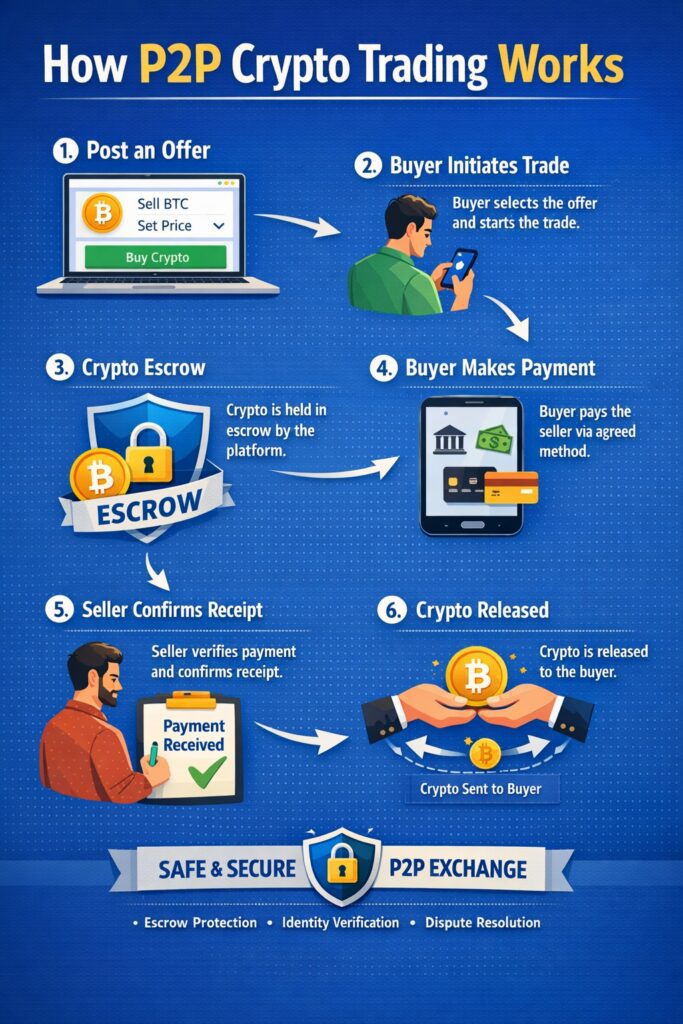
Before we dive into the platforms themselves, let me explain what is p2p trading in the simplest way possible.
Imagine you want to buy some BTC, instead of buying from a traditional exchange where you’re buying from the platform itself.
P2P trading connects you directly with another person who wants to sell their crypto. You send them money through your preferred payment method, maybe bank transfer, PayPal, or even cash if you’re feeling old school.
Once they confirm they’ve received your payment, the platform releases the crypto to your wallet.
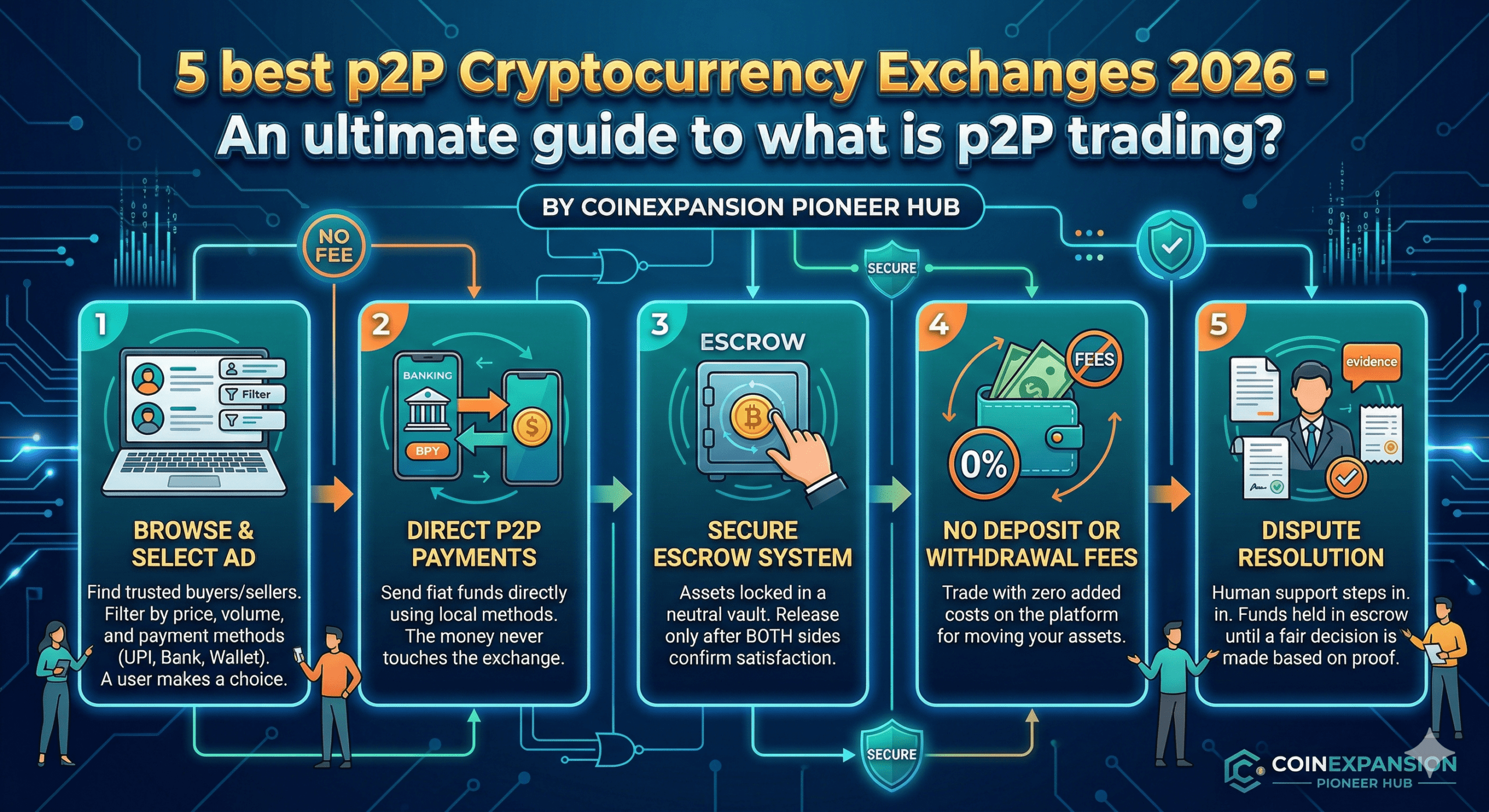
P2P Exchanges uses an escrow system to execute the whole trade. The P2P escrow system acts as a digital “safety box,” ensuring neither the buyer nor the seller gets scammed.
It works in four simple steps.
First, when a trade begins, the platform “locks” the seller’s crypto in a secure vault, making it impossible for them to run away with it.
Next, the buyer sends their payment directly to the seller via their preferred payment method. Since the escrow system can’t see your bank app, the buyer must click “Payment Sent” to signal the move.
The seller then verifies their own account. Once they confirm the money has arrived, they click “Release,” and the platform automatically moves the crypto into the buyer’s wallet.
If a dispute happens, like a buyer lying about paying, the crypto stays locked. A human moderator then steps in, checks the bank receipts from both sides, and manually decides who gets the funds. It’s a bulletproof way to trade safely.
It’s like buying something from a friend, except a trusted middleman is holding the goods until everyone plays fair. Pretty neat, right?
If you’re still choosing your first digital wallet to hold these coins, check out our Guide to the Best Crypto Wallets for 2026
Why Choose P2P Over Traditional Exchanges?
Now, why would anyone look for the best p2p cryptocurrency exchanges instead of using a major regular exchange? Because the best p2p cryptocurrency exchanges give you more payment freedom and better prices.
P2P transactions often come with better prices because you’re dealing directly with other humans who set their own rates. Plus, you get way more flexibility with payment methods.
Some sellers accept Venmo, others prefer Wise, and some might even take gift cards.
It’s a whole different world of options. And for people in countries where traditional banking makes crypto purchases difficult, P2P trading can be an absolute lifesaver.
If you’re looking for the best crypto exchange apps in India to buy crypto with INR, check out this detailed guide on the best crypto exchange app in India to buy crypto with INR
Another benefit is the speed. While bank transfers to traditional margin trading platforms can take days, many P2P transactions are completed in minutes. This is especially useful when you want to take advantage of market opportunities quickly.
Plus, there’s the community aspect. When you trade P2P, you’re dealing with real people, not faceless institutions. Many traders build long-term relationships with their favorite sellers, creating a network of trusted trading partners.
If you’re still wondering what is p2p trading all about, just think of it as the crypto equivalent of buying something from a classified ad, but with a trusted platform making sure everyone plays fair.
The 5 Best P2P Cryptocurrency Exchanges
Speaking of which, let me tell you about the best p2p cryptocurrency exchanges I’ve personally tested and researched.
These aren’t just random picks from Google. I’ve spent countless hours on each platform, made real trades, and dealt with customer support.
When evaluating the best p2p cryptocurrency exchanges, I looked at factors like fees, security, supported currencies, payment methods, and user experience. The platforms that made this list excelled in all these areas.
If you’re wondering what is p2p trading really like in practice, these platforms will show you exactly how it works. So grab your coffee, get comfortable, and let’s explore these five platforms together.
1. Binance P2P
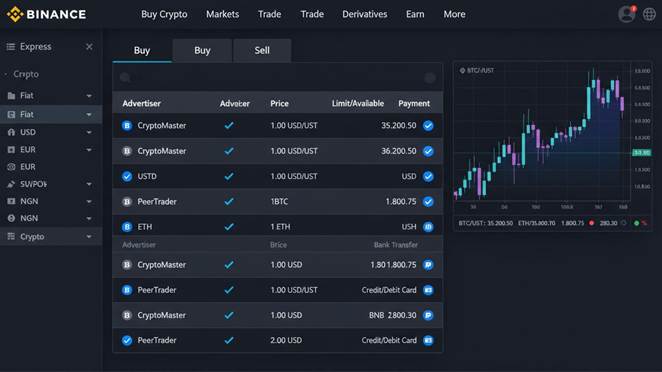
It’s hard to talk about the best p2p cryptocurrency exchanges without mentioning Binance P2P.
First up is Binance P2P, and honestly, it’s hard to talk about crypto without mentioning this giant. Binance is like the Walmart of cryptocurrency exchanges.
Binance is also a FIU-registered cryptocurrency exchange, which makes it one of the best exchanges for Indian users.
They’ve got everything, and their P2P marketplace is no exception.
When you open the Binance P2P section, you’re greeted with hundreds of offers from sellers all around the world.
We’re talking about support for over 100 fiat currencies and more than 800 payment methods. That’s absolutely insane when you think about it.
Key Features of Binance P2P
- Zero trading fees for buyers
- Seller fees range from 0% to 0.35%
- Supports BTC, ETH, USDT, FDUSD, DAI, DOGE, BNB, and TUSD
- Robust escrow system for secure trades
- Comprehensive reputation and rating system
Binance escrow system works like a charm. When you start a trade, the seller’s crypto gets locked up by Binance until the deal is complete. This means they can’t just take your money and run.
The platform also has a pretty solid reputation system where you can see how many trades a person has completed and what their rating is.
Trust me, you wanna stick with sellers who have high completion rates and positive feedback. It’s just common sense.
Another great thing about Binance is their mobile app. You can complete P2P transactions right from your phone, which is super convenient when you’re on the go.
The app has all the same security features as the desktop version, so you don’t have to worry about compromising safety for convenience.
Sign up using this link to claim a $100 voucher and 20% fee rebate for lifetime
For a deeper look at this platform’s other features, read our full Binance Exchange Review.
2. Bybit P2P
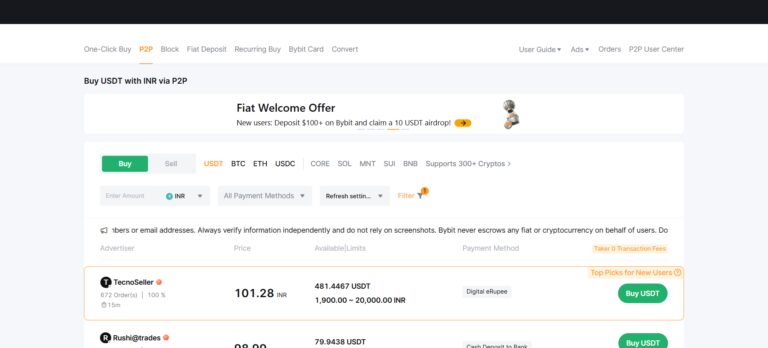
Bybit is quickly becoming one of the best p2p cryptocurrency exchanges for futures traders.
Moving on to Bybit P2P, which has been making serious waves in the crypto community lately. Bybit launched its P2P marketplace a bit later than some competitors, but they’ve really hit the ground running.
The interface is clean, modern, and honestly pretty enjoyable to use. What stands out about Bybit is how they’ve integrated P2P trading into their broader ecosystem.
If you’re already using Bybit for spot or futures trading, having P2P right there in the same app is super convenient.
You don’t need to shuffle money between different platforms.
Key Features of Bybit P2P
- Growing list of supported fiat currencies
- Zero fees for takers
- 24/7 customer support
- New review feature for trader ratings
- Seamless integration with spot and futures trading
Bybit’s P2P section supports a growing number of fiat currencies and payment methods, and they’re constantly expanding. The fees are competitive, and they recently introduced a review feature that lets traders rate each other after completing deals.
The platform has put a lot of effort into making its P2P transactions smooth and secure, with 24/7 customer support ready to step in if anything goes wrong. And let me tell you, having responsive support matters a lot when you’re dealing with money.
Bybit also runs regular promotions for P2P traders, including trading competitions and bonus programs. These can be a nice way to earn some extra rewards while you’re buying and selling crypto. Definitely keep an eye on their announcements page for the latest offers.
Read Bybit Global Exchange review 2026
3. KuCoin P2P
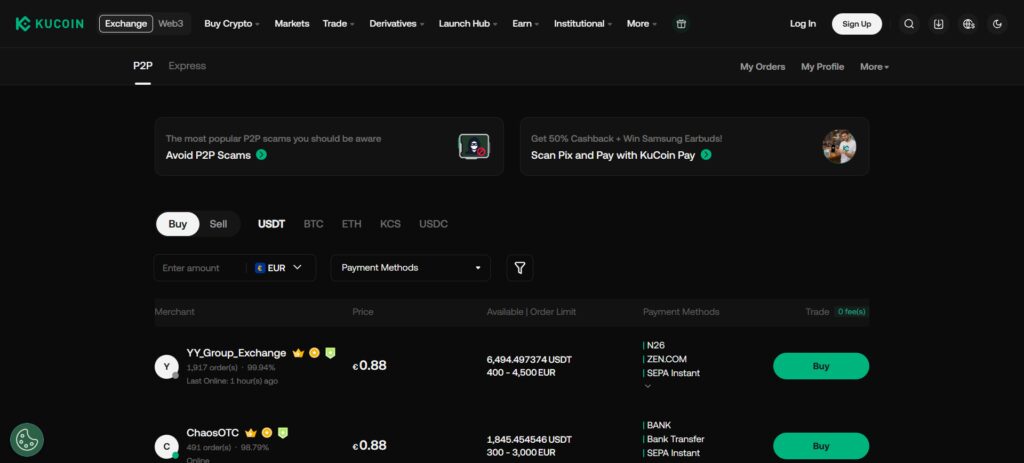
If you want zero fees, KuCoin is among the best p2p cryptocurrency exchanges in 2026.
Now let’s talk about KuCoin P2P, which is often overlooked but definitely deserves your attention. KuCoin calls itself the “People’s Exchange,” and its P2P marketplace lives up to that slogan in many ways.
What I love about KuCoin P2P is the sheer variety of cryptocurrencies available. Sure, you can buy the usual suspects like BTC, ETH, and USDT, but they also support KCS (their native token) and USDC.
This gives you more options if you’re looking to diversify beyond the most common stablecoins.
Key Features of KuCoin P2P
- Zero trading fees for all transactions
- Support for over 30 fiat currencies
- More than 100 payment methods available
- Secure escrow system
- User-friendly interface for beginners
KuCoin P2P offers zero trading fees for all transactions, which is pretty amazing. That’s right, whether you’re buying or selling, you don’t pay any fees to the platform. Kucoin is one of the low-fee crypto exchanges in the industry
The sellers might build their costs into their prices, but at least you’re not getting hit with additional charges from KuCoin itself.
That said, for people who can access it, KuCoin P2P offers a solid, low-cost option for peer-to-peer crypto trading. The interface is straightforward, and the whole process from finding an offer to completing a trade is pretty intuitive even for beginners.
KuCoin also has a strong community aspect, with active forums and social channels where traders can share tips and advice. This can be really helpful when you’re just starting out and have questions about how things work.
Sign up to claim a bonus of up to $500
Check out Kucoin Gem Listing Exchange review 2026
4. BingX P2P
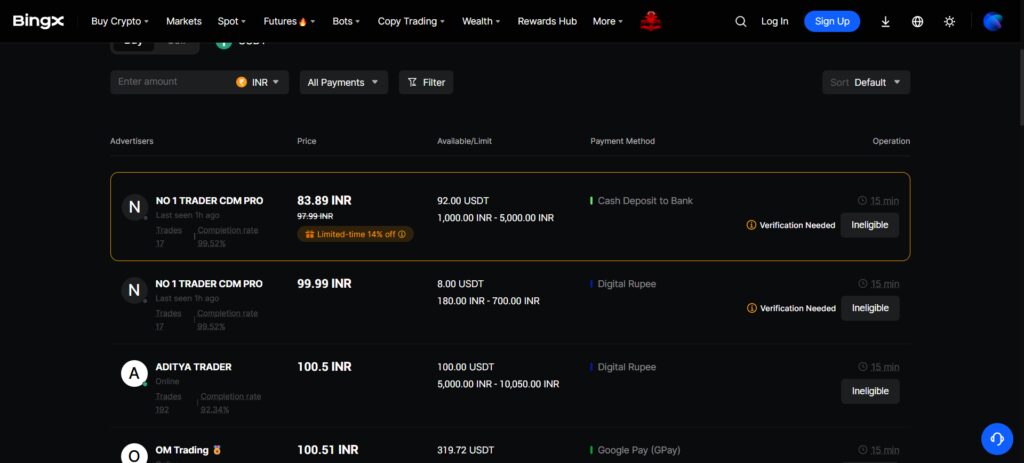
For fast dispute resolution, BingX is one of the best p2p cryptocurrency exchanges.
Next on our list is BingX P2P, and this one is particularly interesting because BingX has been growing like crazy over the past couple of years.
They started as more of a derivatives-focused exchange but have really expanded their offerings.
Their P2P marketplace is relatively new compared to the giants like Binance, but they’re doing some innovative things that are worth paying attention to.
Key Features of BingX P2P
- P2P Expedited Appeal feature (15-minute dispute resolution)
- Partnerships with Chelsea FC and Scuderia Ferrari
- Over 40 million users worldwide
- Competitive fees
- Clean, beginner-friendly interface
BingX recently introduced something called the P2P Expedited Appeal feature, which is designed to resolve disputes in as little as 15 minutes. That’s a massive improvement over the industry standard of around 2 hours.
BingX has also partnered with some major brands like Chelsea FC and Scuderia Ferrari, which adds a layer of credibility and visibility to their platform.
Their P2P marketplace supports the major cryptocurrencies you’d expect, and they’re continuously adding more fiat currencies and payment methods.
One thing that sets BingX apart is its focus on copy trading and social features throughout its platform. While this is more relevant to their futures and spot trading, it shows they’re thinking about building a community, which extends to their P2P marketplace as well.
Sign up and make your first trade to grab a reward of up to $1500
Check out BingX Exchange Review 2026
5. WEEX P2P
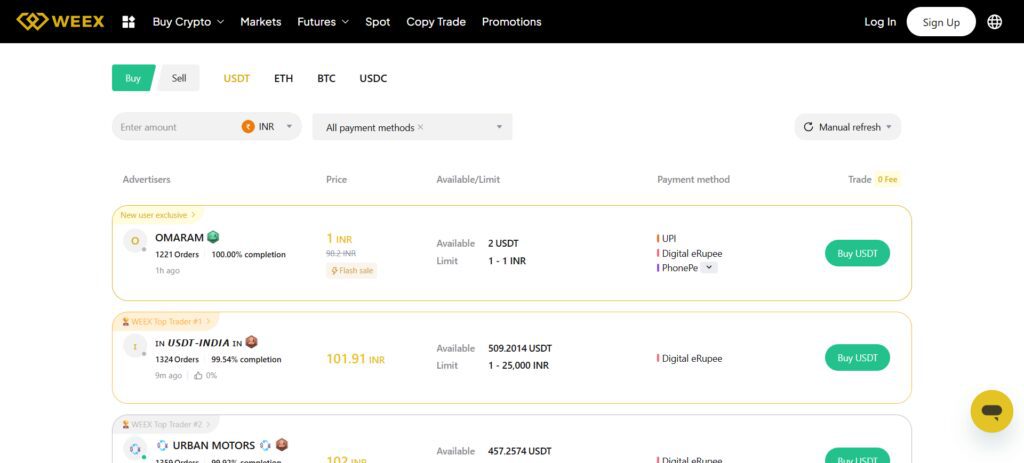
WEEX stands out as one of the best p2p cryptocurrency exchanges for privacy lovers.
Last but definitely not least, we have WEEX exchange and its P2P marketplace. WEEX is probably the least known of the five platforms we’re discussing today, but that doesn’t mean you should ignore it.
Founded in 2018 and headquartered in Dubai, WEEX has been quietly building a solid reputation among traders who value privacy and flexibility.
Key Features of WEEX P2P
- No KYC required for up to 10,000 USDT daily (VIP 0)
- Zero fees for P2P trades
- Supports BTC, ETH, USDT, and USDC
- 1,000 BTC protection fund
- Registered MSB in the US and Canada
Here’s where things get really interesting. WEEX allows you to deposit crypto, trade, and withdraw up to 10,000 USDT per day without completing KYC verification if you’re at VIP level 0. This is pretty rare in today’s regulatory environment.
Now, I’m not saying you should avoid KYC entirely. There are legitimate reasons to verify your identity, including higher limits and increased security.
WEEX’s P2P marketplace supports BTC, ETH, USDT, and USDC with zero fees for trades. The selection is more limited than some competitors, and currently, their P2P market primarily supports Vietnamese Dong and Russian Ruble for fiat currencies, which is definitely a limitation.
However, if those currencies work for you, or if you’re mainly looking to trade crypto-to-crypto, WEEX offers a compelling option.
The platform also boasts some impressive features beyond P2P, including spot trading with over 1,000 cryptocurrencies and futures trading with up to 400x leverage.
If privacy is your main goal, you might also be interested in our list of the Top Non-KYC Exchanges available this year.
Grab a welcome Bonus of up to $30000
Check out the Weex no-KYC Exchange review
Quick Comparison Table
| Exchange | Fees | Best For | KYC Required |
| Binance | 0% for buyers | Selection & Liquidity | Yes |
| Bybit | 0% for takers | Integrated Trading | Yes |
| KuCoin | 0% for all | Zero Fees | Yes |
| BingX | Competitive | Fast Disputes | Yes |
| WEEX | 0% for P2P | Privacy | Optional |
Key Takeaways
So there you have it. Those are the five best p2p cryptocurrency exchanges I’ve researched and tested. Let me summarize the main points for you:
- Binance offers the largest selection with 100+ fiat currencies and 800+ payment methods
- Bybit provides seamless integration with its spot and futures trading platform
- KuCoin stands out with zero fees on all P2P transactions
- BingX offers the fastest dispute resolution with its 15-minute Expedited Appeal feature
- WEEX is the best choice for privacy-conscious traders with no-KYC options
Each one has its own strengths and weaknesses, and the right choice really depends on your specific needs and circumstances.
If you want the biggest selection and highest liquidity, Binance is hard to beat. If you’re already trading on Bybit and want everything in one place, their P2P marketplace makes perfect sense.
If zero fees on all transactions sound appealing, KuCoin is worth a look. If fast dispute resolution and innovative features matter to you, check out BingX. And if privacy and no-KYC options are priorities, WEEX might be your best bet.
Check out the Crypto Trading for Beginners Guide 2026: The Ultimate A-Z Handbook
Safety Tips for P2P Trading
Let me circle back to what is p2p trading one more time because I think it’s important to really understand the concept. When you engage in P2P transactions, you’re participating in one of the most fundamental aspects of cryptocurrency.
Even when using the best p2p cryptocurrency exchanges, safety should be your top priority.
I remember my first P2P trade like it was yesterday. I was nervous as heck. But you know what? It worked perfectly. That experience taught me what is p2p trading really about and showed me that it isn’t scary or complicated.
Essential Safety Guidelines
- Always check the seller’s rating and completion rate before trading
- Read recent reviews if they’re available
- Start with smaller amounts until you’re comfortable
- Never release crypto from escrow until payment is confirmed
- Use bank transfers when possible for added security
The beauty of P2P transactions is that you’re in control, but with that control comes responsibility.
I remember my first P2P trade like it was yesterday. I was nervous as heck. I found a seller with a good rating, initiated the trade, and then sat there staring at my phone waiting for the crypto to appear in my wallet after I sent the payment.
My heart was racing. But you know what? It worked perfectly. The seller was professional, the escrow system did its job, and within minutes I had my crypto.
3erThat experience taught me that P2P trading isn’t scary or complicated. It’s just people helping people access the world of cryptocurrency.
Want to buy crypto cheaply. Read the following article: The Cheapest Ways to Buy Crypto Instantly in 2026 (Stop Wasting Money!)
Always store your cryptocurrency in a hardware wallet
Check out the 4 best hardware wallets
Stop watching from the sidelines while the future gets built. Join the CoinExpansion Pioneer Hub today and get the early alpha, expert signals, and community support you need to own the next bull run.
Frequently Asked Questions
Q1: Is P2P trading legal?
Yes, but you must understand what is p2p trading laws in your specific country. However, some countries have banned cryptocurrency entirely, so always check your local laws before getting started. The best p2p cryptocurrency exchanges typically have compliance teams that monitor regulatory changes.
Q2: How do I know if a seller is trustworthy?
Check their completion rate, rating, and recent reviews. Stick with sellers who have high completion rates (above 95%) and positive feedback from other traders. Most platforms display this information clearly on the seller’s profile.
Q3: What happens if something goes wrong with my trade?
All major P2P platforms have dispute resolution systems. If there’s an issue, you can open an appeal, and the platform’s support team will investigate. BingX even offers 15-minute expedited appeals for faster resolution.
Q4: Can I make money as a P2P trader?
Yes, many people make a living by buying crypto at lower prices and selling at a premium on P2P markets. It requires capital, time, and market knowledge, but it’s definitely possible. Some traders complete hundreds of P2P transactions per day.
Q5: Do I need to complete KYC to use P2P trading?
It depends on the platform. Most exchanges require KYC, but WEEX allows trading up to 10,000 USDT daily without verification. Keep in mind that completing KYC usually gives you higher limits and increased security.
Q6: What payment methods are accepted?
This varies by platform and seller. Common options include bank transfers, PayPal, Wise, Venmo, and even cash. The best p2p cryptocurrency exchanges will clearly show you what payment methods each seller accepts.
Q7: How long does a P2P trade take?
Most P2P trades complete within minutes to a few hours, depending on the payment method used. Bank transfers might take longer than instant payment apps. The key is that both parties need to confirm the transaction before the crypto is released from escrow.
Q8: Can I cancel a P2P trade?
You can usually cancel a trade before payment is made. However, once you’ve sent payment, you’ll need to wait for the seller to release the crypto or open a dispute if there’s an issue. Always make sure you want to proceed before sending any money.
Q9: Are there limits on how much I can trade?
Yes, most platforms have limits based on your verification level. Unverified accounts typically have lower limits, while verified accounts can trade larger amounts. Check each platform’s specific limits before starting.
Q10: What cryptocurrencies can I buy through P2P?
This depends on the platform. Most support major cryptocurrencies like Bitcoin, Ethereum, and USDT. Some platforms like KuCoin offer a wider variety, including their native tokens. Always check what’s available on your chosen platform.