Crypto Coins List: Types of Cryptocurrencies (2026 Edition)
If you open an app like CoinGecko or CoinMarketCap today, you are going to see something that looks less like a financial market and more like a chaotic, infinite scroll of nonsense.
There are over 25,000 active cryptocurrencies listed right now. It is overwhelming. It is like walking into a supermarket that sells everything from apples to spaceship parts, and everything is just labeled “Product.”
Most beginners and even some people who have been here for years make the fatal mistake of treating all types of crypto the same. They look at a chart and think, “Oh, Dogecoin is cheap, and Bitcoin is expensive, so Dogecoin is a better deal.”
That is like comparing a penny to a share of Apple stock. They aren’t even playing the same game. To navigate this, you need a structured crypto coins list and a breakdown of the distinct types of cryptocurrencies that investors actually trust.
In 2026, the crypto market has matured into distinct, specialized sectors. We have coins that are trying to be money, tokens that are trying to be oil, assets that represent literal gold bars in a London vault, and AI agents that negotiate for you.
You wouldn’t put your retirement savings into a lottery ticket, and you shouldn’t put your “safe” money into a high-risk meme coin without knowing the difference between these types of crypto.
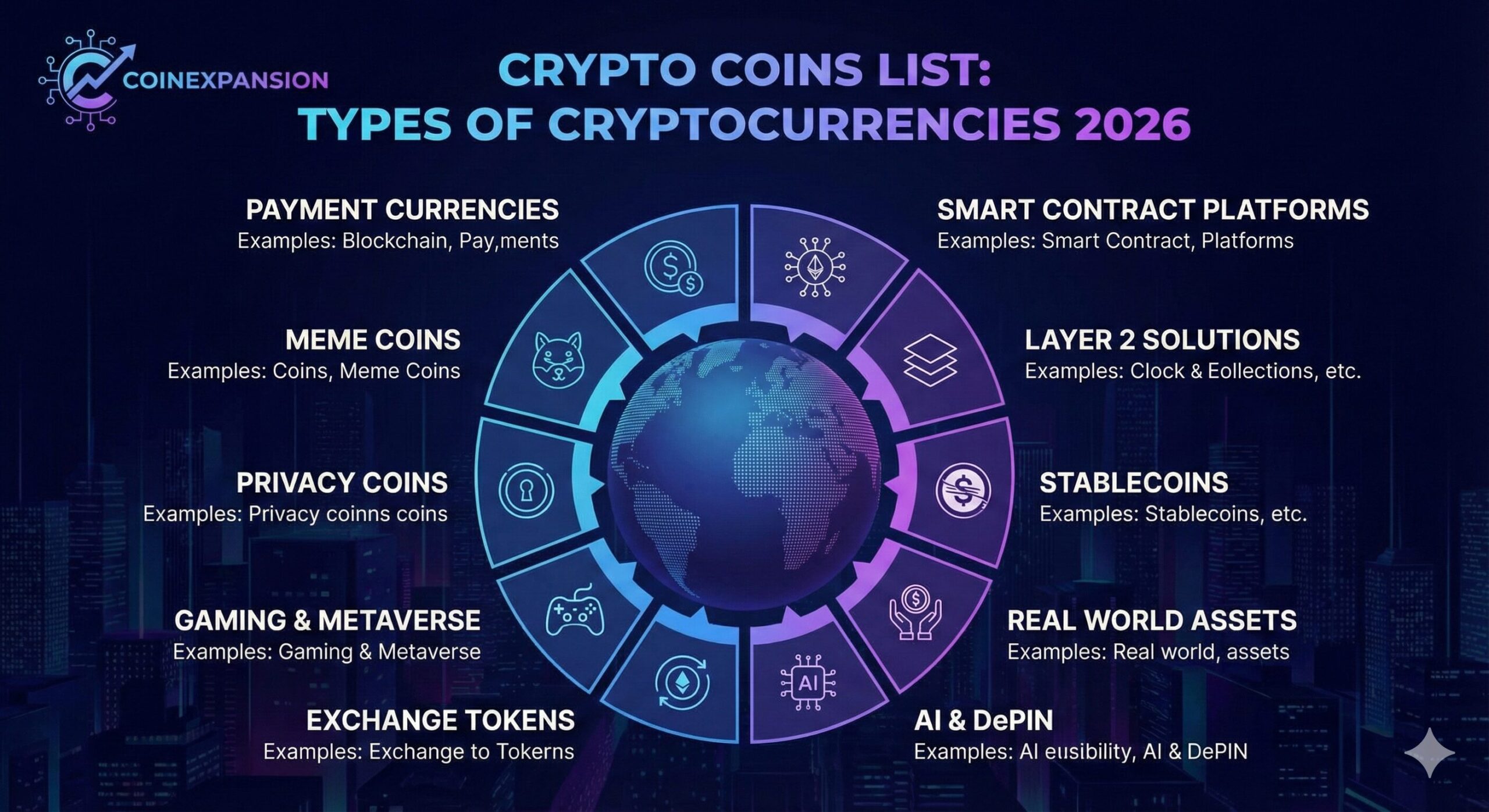
This guide is your map. We are going to break down the entire crypto ecosystem into 10 clear categories.
I’m going to explain exactly what each of these types of cryptocurrencies does, why it exists, the risks involved, and give you the definitive crypto coins list and breakdown for 2026. By the end of this, you won’t just see a list of tickers, you’ll see a structured economy.
The “Taxonomy” of Crypto
Before we dive into the specific types of cryptocurrencies, let’s set the stage. In biology, you divide animals into mammals, reptiles, and birds. In crypto, we divide assets by their Utility (what they do) and their Layer (where they live).
- Layer 1s (Coins): These are the cities. They provide the land, the security, and the rules. (e.g., Bitcoin, Ethereum).
- Layer 2s (Scaling): These are the express highways built on top of the cities to reduce traffic. (e.g., Arbitrum, Base).
- dApps (Tokens): These are the businesses built inside the cities. (e.g., Uniswap, Aave).
If you keep that “City vs. Business” analogy in your head, understanding the different types of crypto will be much easier. Let’s start with the grandfather of them all.
Category 1: Payment Currencies (The “Digital Money”)
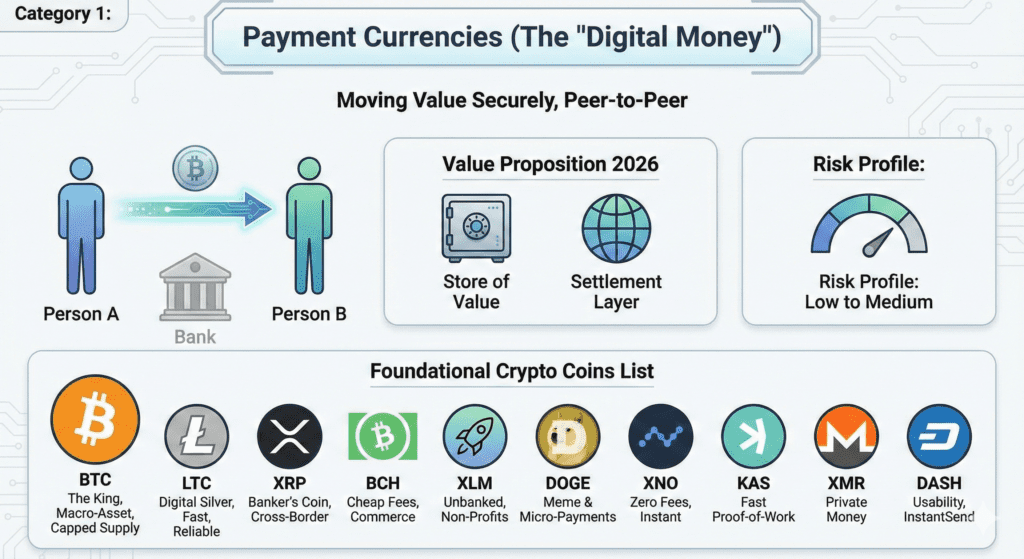
This is where crypto started. Think of these types of cryptocurrencies simply as digital cash.
They don’t try to run video games or complicated computer programs. They have one simple job: sending money from Person A to Person B safely, without needing a bank in the middle.
- The Value Proposition (Why people want them): In 2026, most people don’t use these to buy coffee. Instead, they treat them like a digital piggy bank or “Digital Gold.” It is a way to save money outside of a regular bank.
- The Risk Profile (Are they safe?): These are generally safer than other types of crypto because they have been around the longest.
Here are the main examples:
- Bitcoin (BTC): The King. Think of this as “Digital Gold.” It is the most famous and trusted. There is a limited amount of Bitcoin in the world, which makes it very valuable to big companies and investors.
- Litecoin (LTC): The “Digital Silver.” It works just like Bitcoin, but it is four times faster. It is boring, but it works perfectly every time.
- Ripple (XRP): The Banker’s Coin. Bitcoin is for regular people, but XRP is for big banks. It helps them send money to other countries in seconds for almost zero cost.
- Bitcoin Cash (BCH): The Spender. This version of Bitcoin is designed to be very cheap to send. It is great for actually buying things at stores.
- Stellar (XLM): The Helper. It is like XRP, but instead of helping banks, it helps regular people and charities in developing countries send money easily.
- Dogecoin (DOGE): The Fun Coin. It started as a joke with a dog picture on it. But now, so many people use it that it has become real money. It’s great for giving small tips online.
- Nano (XNO): The Free One. Sending Nano costs zero fees and happens instantly.
- Kaspa (KAS): The New Speedster. A newer coin that is incredibly fast and becoming very popular in 2026.
- Monero (XMR): The Secret Coin. It focuses on privacy. When you spend it, no one can see where the money came from or where it went.
- Dash (DASH): The Easy One. It is built to be super fast and easy to use, almost like using a payment app like Venmo.
10 Safest Cryptocurrencies to Invest in 2026 (Price Predictions 2026–2030)
Category 2: Smart Contract Platforms (Layer 1s)
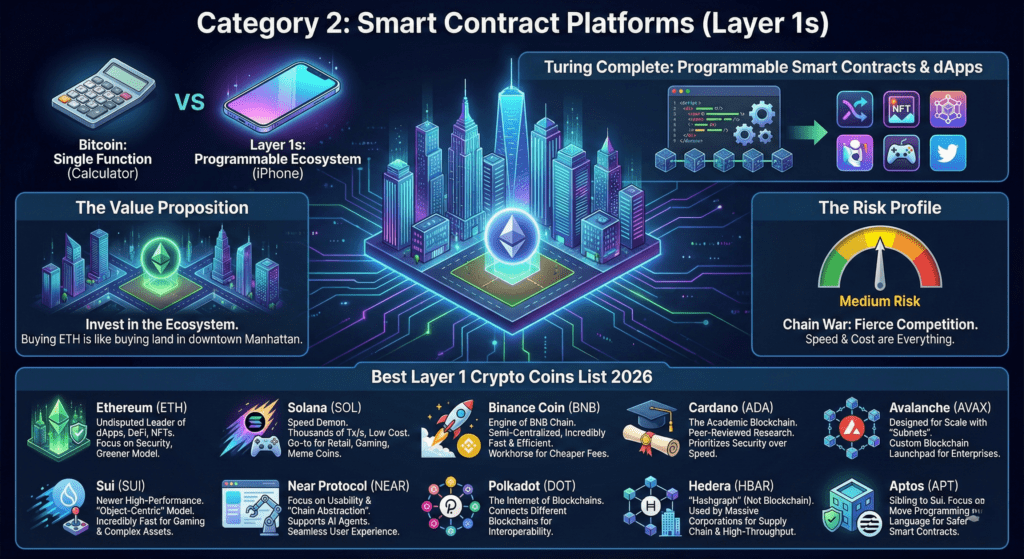
Think of Bitcoin like a simple pocket calculator. It does one thing really well: math with money.
These types of cryptocurrencies are like the latest iPhone. They are smart and “programmable.” This means people can build apps on top of them, just like you download games on your phone.
These apps use “Smart Contracts.” Imagine a digital vending machine. You put money in, and it automatically gives you a snack without a shopkeeper needing to be there. That is what these coins do for money and apps.
- The Value Proposition (Why people buy them): Imagine these coins are digital cities. Buying them is like buying land in a busy city like New York. The more people who build shops and houses (apps) in that city, the more valuable your land becomes.
- The Risk Profile (Is it risky?): A little bit (Medium). It is like a big race. All these cities are fighting to see who can be the fastest and cheapest.
Here are the main players:
- Ethereum (ETH): The King of the Cities. Most digital apps and games are built here. It is safe, popular, and has recently become much better for the environment.
- Solana (SOL): The Speed Racer. This one is super fast and very cheap to use. People love it for playing games and crypto trading because it feels as instant as the regular internet.
- Binance Coin (BNB): The Fast Worker. It is the native token of Binance, which makes it very efficient. It’s great for people who want to save money on fees.
- Cardano (ADA): The Professor. It is built by scientists who study everything carefully before adding it. It might be slower to change, but it breaks less often.
- Avalanche (AVAX): The Network. It lets businesses build their own private mini-blockchains that all connect to one big network. It’s great for big companies.
- Sui (SUI): The Gamer. Built by engineers who used to work at Facebook. It is designed to be super fast, making it perfect for complicated video games.
- Near Protocol (NEAR): The Invisible Helper. It makes using crypto apps so easy that you might not even realize you are using a blockchain at all. It is also helping Artificial Intelligence (AI) robots work together.
- Polkadot (DOT): The Connector. It acts like a bridge that lets all the different blockchains talk to each other.
- Hedera (HBAR): The Business Pro. It works a little differently than a normal blockchain (it’s called a Hashgraph). Huge companies like Google and IBM use it to keep track of their supplies.
- Aptos (APT): The Safety Expert. Also built by former Facebook engineers, it focuses on being the safest place to build apps so they don’t crash.
Category 3: Layer 2 Scaling Solutions (The “Fast Lanes”)
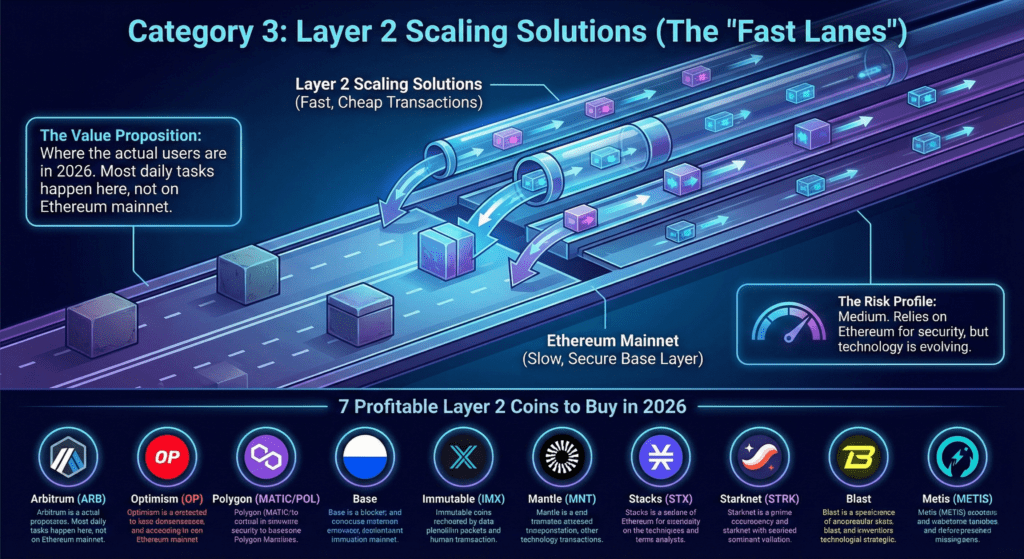
Ethereum is great, but it can be slow. Scaling solutions are specific types of cryptocurrencies that sit on top of Ethereum. They process transactions quickly and cheaply, then bundle them up and save the final result to Ethereum.
The Value Proposition: This is where the actual users are in 2026. Most people don’t use the Ethereum mainnet anymore; they use these types of crypto for daily tasks.
The Risk Profile: Medium. They rely on Ethereum for security, but the technology is still evolving.
7 Profitable Layer 2 Coins to Buy in 2026
Examples:
- Arbitrum (ARB): The current king of DeFi on Layer 2. It holds the most value and has a massive ecosystem of trading apps.
- Optimism (OP): The builder of the “Superchain.” They provide the tech stack (OP Stack) that other companies (like Coinbase) use to build their own chains.
- Polygon (MATIC/POL): Originally a sidechain, now an ecosystem of ZK-rollups (Zero Knowledge). It has massive partnerships with brands like Nike and Starbucks.
- Base: Coinbase’s own Layer 2. (Note: It currently has no token, but the ecosystem is massive.
- Immutable (IMX): A Layer 2 specifically built for gaming. It offers zero gas fees for minting NFTs, making it perfect for video games with millions of items.
- Mantle (MNT): A modular Layer 2 with a massive treasury that focuses on high yields for users.
- Stacks (STX): A Layer 2 for Bitcoin. It brings smart contracts and apps to the Bitcoin network, unlocking the trillions of dollars of value stored there.
- Starknet (STRK): Uses advanced math (ZK-STARKs) to provide massive scaling potential.
- Blast: A Layer 2 that gives you native yield (interest) on your ETH just for holding it there.
- Metis (METIS): Focuses on decentralizing the “sequencer” (the computer that orders transactions) to make the network more democratic.
Category 4: Stablecoins (The “Safe Haven”)
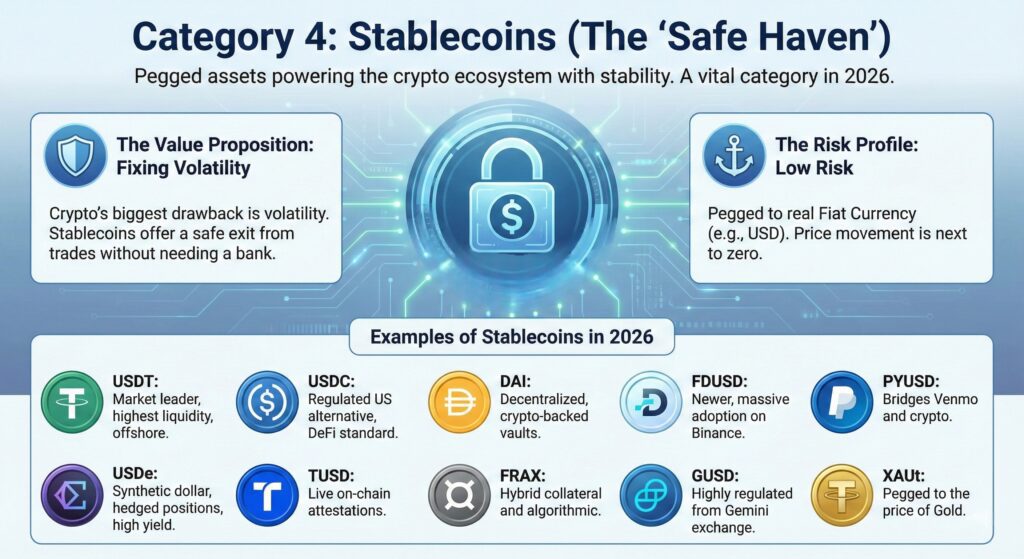
We can’t talk about types of crypto without talking about the cash that powers it. These are tokens pegged to a stable asset, usually the US Dollar ($1.00). In 2026, this is one of the most vital categories on any crypto coins list.
The Value Proposition: Volatility is crypto’s biggest drawback. Stablecoins fix it. Unlike other types of cryptocurrencies, they let you exit a trade without going back to a bank.
The Risk Profile: Low. These are pegged to real Fiat Currency. The price movement of these currencies is next to zero.
Examples:
- Tether (USDT): The market leader. It has the most liquidity and is used by almost every trader, though its offshore nature makes some people nervous.
- USD Coin (USDC): The regulated alternative. Issued by Circle in the US, it is the standard for DeFi and corporate money.
- Dai (DAI): Decentralized. It is backed by other crypto assets (like ETH) locked in vaults, not by dollars in a bank account.
- First Digital USD (FDUSD): A newer stablecoin that gained massive adoption on Binance.
- PayPal USD (PYUSD): Issued by PayPal. It bridges the gap between your Venmo app and the crypto world.
- Ethena USDe (USDe): A “synthetic” dollar. Instead of holding cash, it holds crypto positions that are hedged (protected) against price drops to maintain a $1 value. It pays a high yield.
- TrueUSD (TUSD): Uses live on-chain attestations to prove they have the money in the bank every second.
- Frax (FRAX): A hybrid stablecoin that uses both collateral and algorithms to keep its peg.
- Gemini Dollar (GUSD): A highly regulated stablecoin from the Gemini exchange.
- Tether Gold (XAUt): A stablecoin pegged to the price of Gold, not the Dollar.
Checkout Safest Stablecoins to Hold in 2026 (The Boring Crypto That Pays Your Rent)
Category 5: Real World Assets (RWAs) & Security Tokens
Think of this as the “grown-up” table of crypto.
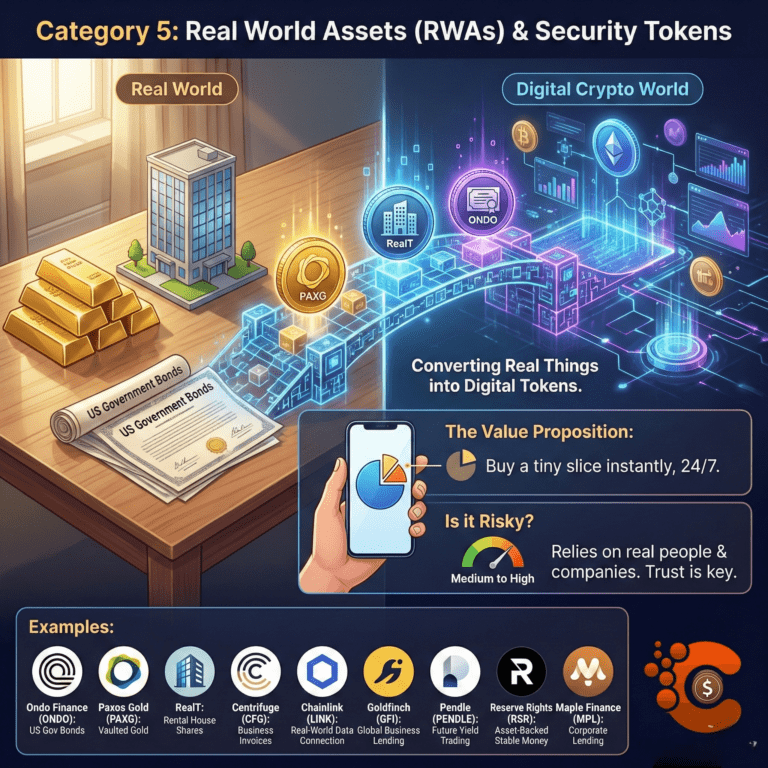
Usually, crypto is all digita it only exists on the internet. But these types of cryptocurrencies are different. It takes real things from the physical world, like gold bars, houses, or government bonds, and turns them into digital tokens.
- The value proposition (Why people want them): Imagine you want to buy a tiny piece of a big office building or a bar of gold, but you don’t have enough money for the whole thing. These tokens let you buy just a small slice of it, instantly, even on a Saturday night.
- The risk profile (Is it risky?): Yes, a bit (Medium to High). Why? Because these types of crypto (tokens) rely on real people in the real world. You have to trust that a real company is actually holding that gold bar or collecting the rent for you. If that company lies or goes out of business, your token could lose its value.
Here are some examples:
- Ondo Finance (ONDO): Lets you invest in U.S. government bonds (which pay you interest) using crypto.
- Paxos Gold (PAXG): Buying this token is like buying a real gold bar that is locked in a vault in London. You own the gold without having to carry it.
- RealT: Lets you buy a piece of a rental house. When the people living in that house pay rent, you get a share of that money sent to your digital wallet.
- Centrifuge (CFG): Helps small businesses turn their unpaid bills (invoices) into tokens so they can borrow money against them.
- Chainlink (LINK): The Messenger. It connects real-world information (like the price of gold or interest rates) to the blockchain so everything works correctly.
- Goldfinch (GFI): Lets crypto investors lend money to real businesses in countries that need it.
- Pendle (PENDLE): A fancy tool that lets you trade the future interest (profit) you might earn, separate from the money you invested.
- Polymesh (POLYX): A special blockchain built just for these kinds of strict, rule-following tokens.
- Reserve Rights (RSR): A tool for making new kinds of stable money backed by different real-world items.
- Maple Finance (MPL): A place where big crypto investors can lend money to big real-world companies.
Checkout 6 Best Real World Asset (RWA) Crypto projects 2026 list: The “BlackRock” Watchlist
Category 6: AI & DePIN (The Future Tech)
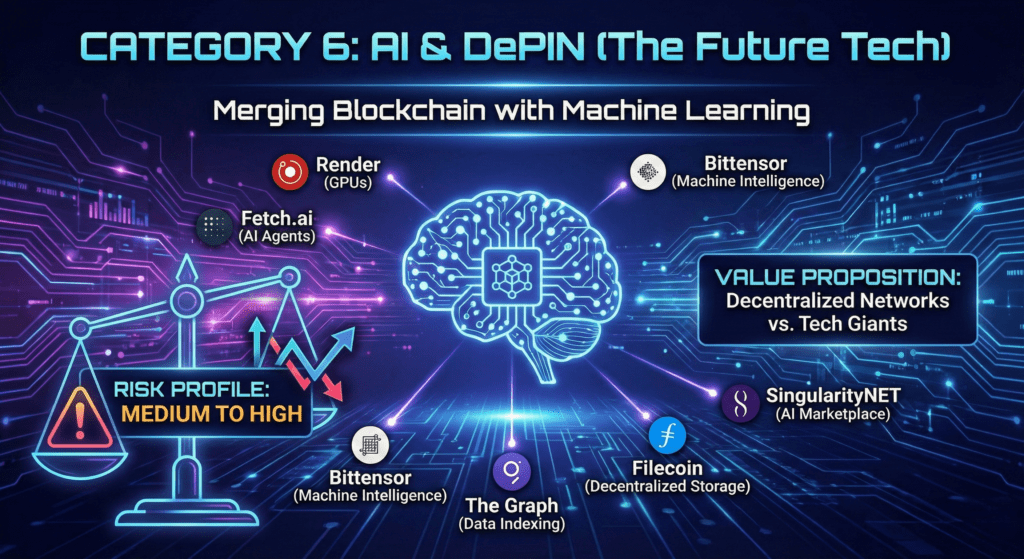
Artificial Intelligence needs Data and Compute. Crypto networks are perfect for crowdsourcing both. This sector is exploding, and any top AI crypto coins list 2026 will include these giants. These are types of crypto that merge blockchain with machine learning.
The Value Proposition: Instead of paying Amazon or Google, companies pay a decentralized network.
Risk profile: (Medium to High) Look, we have to be real here. AI crypto is high-risk, high-reward. The biggest danger is “vaporware” projects that promise the moon because AI is “hot” right now, but actually deliver nothing. Imagine buying a ticket for a train that never shows up; that happens here.
Also, can these decentralized networks really beat tech giants like Google? It’s a tough fight. Prices swing wildly, too. You might see double-digit drops while you’re just grabbing coffee. It’s exciting tech, but strictly play with money you can afford to lose.
Examples:
- Render (RNDR/RENDER): The “Airbnb for GPUs.” You can rent out your gaming PC’s graphics card to help render Hollywood movies or train AI models.
- Fetch.ai (FET): Creates “AI Agents.” These are software bots that can perform tasks for you—like booking a flight or finding the cheapest exchange rate—autonomously.
- Bittensor (TAO): A marketplace for machine intelligence. It rewards computers for training AI models. It’s trying to build a decentralized ChatGPT.
- The Graph (GRT): The “Google” of blockchain data. It indexes data so AI agents can read and understand what is happening on-chain.
- Near Protocol (NEAR): As mentioned in L1s, NEAR is pivoting to become the home for “User-Owned AI”.
- Filecoin (FIL): AI needs massive data storage. Filecoin provides decentralized, censorship-resistant storage.
- Helium (HNT): “DePIN” (Decentralized Physical Infrastructure). People run hotspots to create a wireless network for IoT devices and 5G phones.
- Theta Network (THETA): Decentralized video streaming. It uses your spare bandwidth to help stream video, reducing costs for platforms like YouTube or Twitch.
- Ocean Protocol (OCEAN): A marketplace for data. It allows you to sell your data to AI researchers without giving up your privacy.
- SingularityNET (AGIX): One of the oldest AI marketplaces, allowing anyone to create, share, and monetize AI services.
Checkout 7 Best DePIN Crypto Projects for Passive Income in 2026
5 AI Crypto Coins That Could 50x in 2026 (The “Nvidia” of Blockchain)
Category 7: Exchange Tokens (The “Casino Chips”)
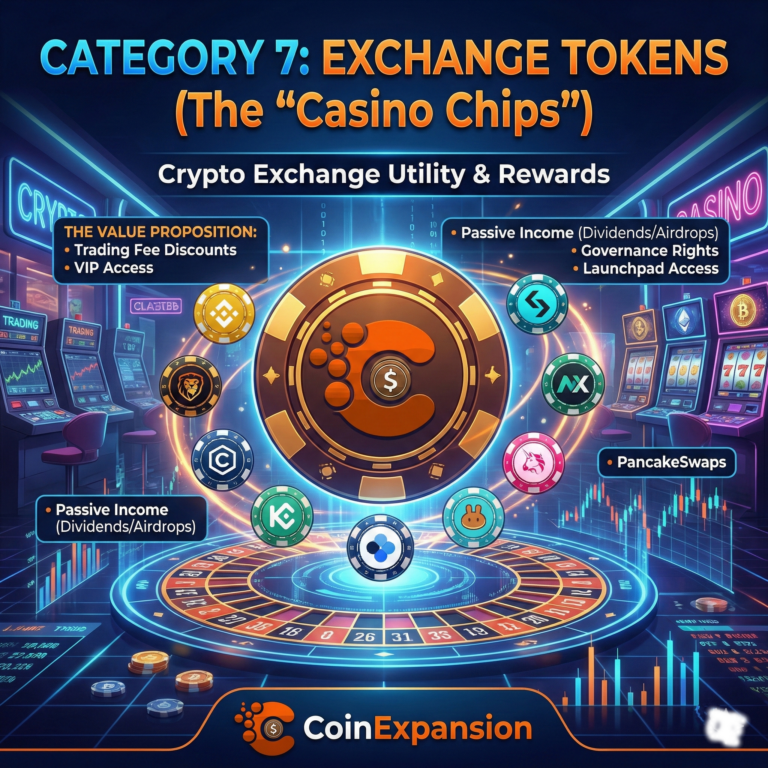
These are tokens issued by major crypto exchanges. When categorizing types of cryptocurrencies, these function like membership points or stock in the casino itself.
There is a difference between coins and tokens. Check the article below
The Ultimate Guide to the Difference Between Crypto Coins and Tokens (2026 Update)
The Value Proposition: You add these to your crypto coins list to get discounts on trading fees or access to new token sales at the best crypto margin trading platforms.
Holding Exchange tokens not only helps in reducing trading fees but also opens multiple gateways to earn passively. If you hold $300 worth of MX token on MEXC Exchange, then you become an automatic participant in every airdrop launch, which helps you earn crypto for free passively every day or week by just holding MX token at MEXC.
Risk Profiles: 80 to 90% of Exchange tokens provides great utility and can also proves a highly profitable investment when it comes to the token price but Think of these tokens like stock in a specific company.
The massive risk here is that the exchange itself fails. If the platform gets hacked, goes bankrupt, or gets shut down by the government, your tokens can become worthless overnight.
We call this “counterparty risk” you are betting entirely on one business’s survival. Unlike Bitcoin, which lives everywhere, these tokens depend on a single team. If traders decide to leave the exchange, the value of your tokens leaves with them.
Examples:
- Binance Coin (BNB): The biggest one. Used for discounts on Binance Exchange and to pay gas on BNB Chain.
- Leo Token (LEO): Issued by Bitfinex. It offers fee discounts and burns (buybacks) from the exchange’s revenue.
- Cronos (CRO): The native token of Crypto.com. Used for their Visa card rewards and huge marketing campaigns.
- KuCoin Token (KCS): Pays out a daily dividend to holders from the Kucoin exchange’s trading fees.
- OKB (OKB): The utility token for the OKX exchange.
- Bitget Token (BGB): A rising star in 2025/2026 as Bitget gained market share.
- GateToken (GT): Used on the Gate.io exchange for VIP levels and gas.
- MX Token (MX): The token for MEXC exchange, known for listing small-cap gems early.
- Uniswap (UNI): (DEX Token) The governance token for the biggest decentralized exchange.
- Cake (CAKE): The token for PancakeSwap, used for high-yield farming.
Checkout 7 Best Crypto Exchange Tokens List 2026
Category 8: Gaming & Metaverse (The Playground)
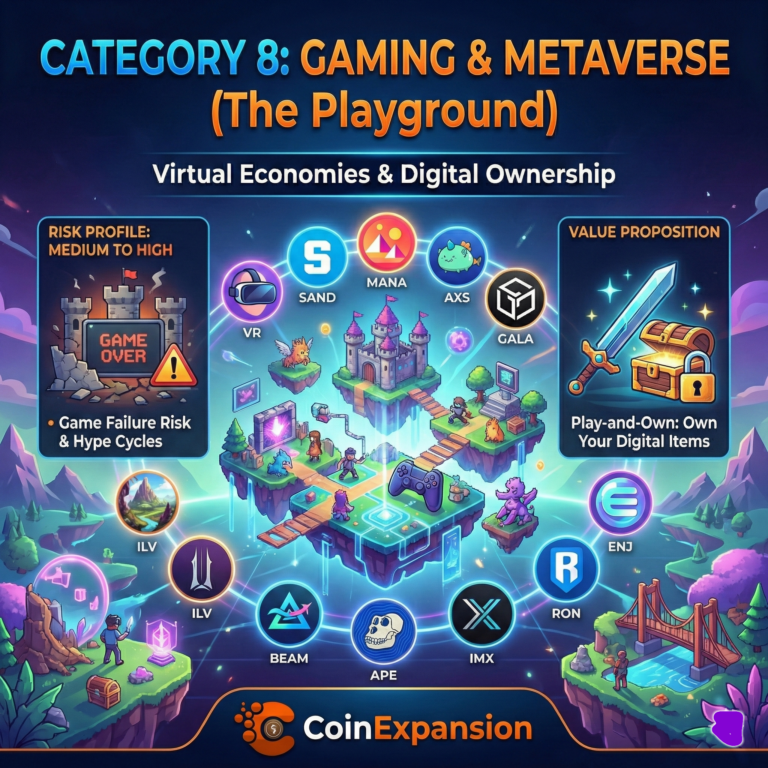
In 2026, gamers are realizing that owning digital items is better than renting them. These types of cryptocurrencies power virtual economies.
The Value Proposition: “Play-to-Earn” has evolved into “Play-and-Own.”
Risk Profile: (Medium to high) Let’s be real: making a genuinely fun game is incredibly hard. For every hit like Fortnite, thousands of games flop. The biggest risk here is that the game just isn’t fun. If gamers get bored and quit, the in-game economy crashes, and your tokens become worthless.
Also, watch out for pure hype. We’ve seen virtual land sell for millions, then plummet when the buzz died. If a game’s economy is broken where everyone plays just to sell rewards the price tanks fast. Only bet on games people actually want to play, not just watch trailers for.
Examples:
- The Sandbox (SAND): A Minecraft-style world.
- Decentraland (MANA): Virtual reality world owned by users.
- Axie Infinity (AXS): The original monster battler.
- Gala Games (GALA): A studio building multiple games.
- Illuvium (ILV): High-fidelity “AAA” blockchain game.
- Beam (BEAM): A gaming-focused network.
- ApeCoin (APE): Currency of the Bored Ape ecosystem.
- Immutable (IMX): Infrastructure for web3 games.
- Ronin (RON): Blockchain for social games.
- Enjin Coin (ENJ): Tools for integrating NFTs.
7 Best Crypto Gaming Coins 2026
Category 9: Privacy Coins (The Secret Service)
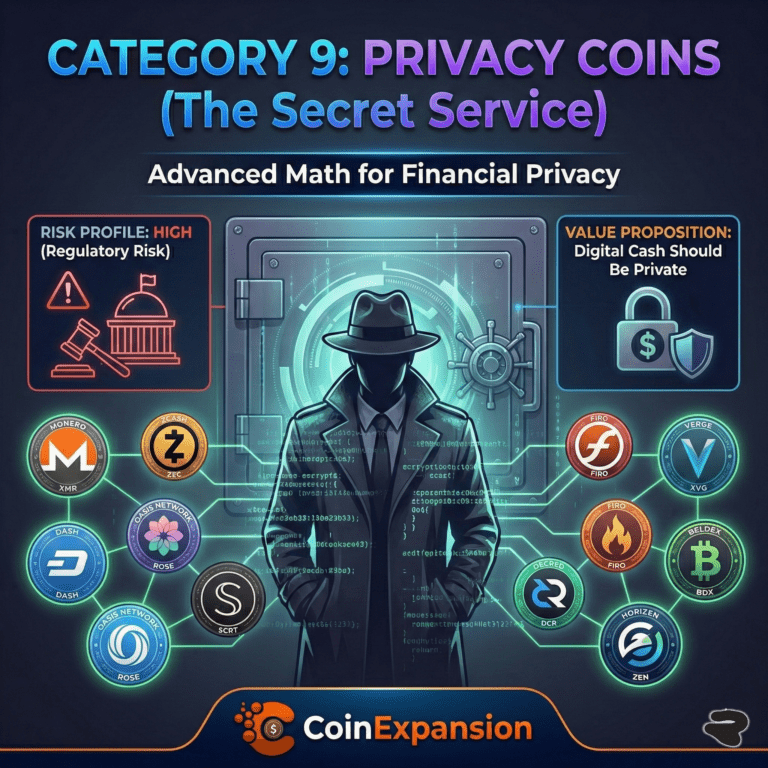
Crypto is generally transparent. Privacy coins are specific types of cryptocurrencies that use advanced math to hide the sender, receiver, and amount. When consulting any crypto coins list regarding types of cryptocurrencies 2026, note that these face high regulatory scrutiny.
The Value Proposition: Digital cash should be private. These types of crypto ensure financial privacy.
The Risk Profile: High (Regulatory risk).
Examples:
- Monero (XMR): The gold standard of privacy.
- Zcash (ZEC): Offers “optional” privacy.
- Dash (DASH): Offers “PrivateSend” mixing.
- Oasis Network (ROSE): “Smart Privacy” for contracts.
- Secret Network (SCRT): Enables encrypted smart contracts.
- Decred (DCR): Focuses on privacy and governance.
- Firo (FIRO): Uses “Lelantus” protocol.
- Verge (XVG): Hides user IP addresses.
- Beldex (BDX): Focused on private messaging.
- Horizen (ZEN): Offers optional privacy features.
Category 10: Meme Coins (The “Lottery Tickets”)
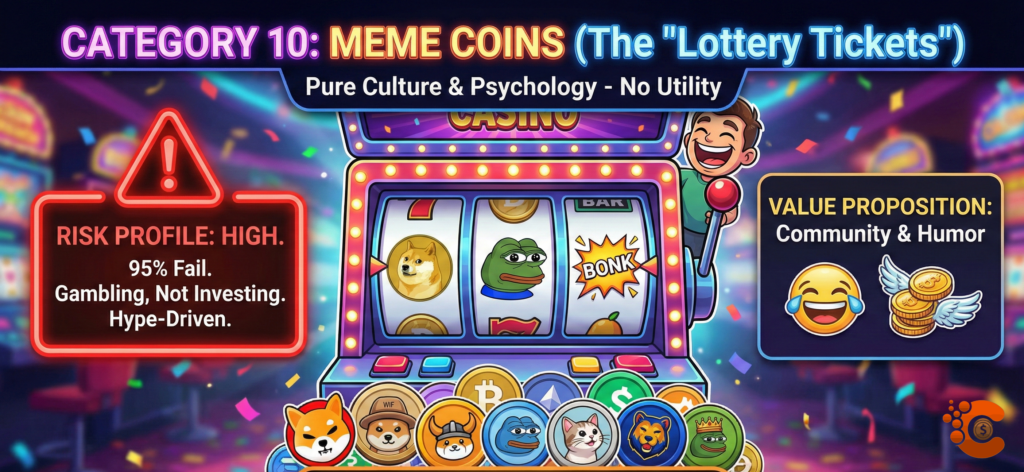
We have to mention them. Among all types of crypto, these have no utility. They are pure culture and psychology.
The Value Proposition: Community, humor, and the chance of massive returns. They are the “retail liquidity” section of the crypto coins list.
The Risk Profile: (High) 90% to 95% meme coins reach nowhere and are only built to destroy your money. Let’s be brutally honest: this isn’t investing, it’s straight-up gambling. These coins don’t actually do anything. Their value is purely based on hype, and that hype can vanish in seconds. Scams and “rug pulls” are everywhere here. You might hit the jackpot, sure, but are you really willing to watch your money go to zero? Treat this like a Vegas trip: have fun, but don’t bet the rent money.
Examples:
- Dogecoin (DOGE): The original.
- Shiba Inu (SHIB): The “Dogecoin Killer.”
- Pepe (PEPE): Pure meme culture.
- Bonk (BONK): The dog coin of Solana.
- Dogwifhat (WIF): A dog with a hat.
- Floki (FLOKI): Focused on branding.
- Brett (BRETT): Popular on Base.
- Popcat (POPCAT): A cat meme coin.
- Mog Coin (MOG): Cultural dominance.
- Book of Meme (BOME): Experimental meme storage.
7 Best Penny Cryptocurrencies to Hit $1 in 2026 (The “Inevitable” List)
Conclusion: How to Build a Portfolio in 2026
Now that you have the map of the different types of cryptocurrencies, how do you pack your bag? You don’t need to buy one from every category. In fact, that’s a bad idea. When you look at the full crypto coins list types of cryptocurrencies 2026 provides, remember that a balanced approach wins the race.
A balanced “Coinexpansion Standard” portfolio for 2026 typically looks like this:
- The Foundation (50%): Payment Currencies (BTC) and Top Layer 1s (ETH, SOL). This is your safety net.
- The Growth (30%): Emerging Layer 2s and Infrastructure. This utilizes specific types of crypto to catch tech trends.
- The Specialist (15%): Pick a sector you love from the crypto coins list.
- The Degen Fund (5%): Meme coins.
Next 1000x Crypto 2026 – 10 Coins That Could Explode
The market isn’t a monolith anymore. By understanding these 10 types of cryptocurrencies, you are no longer just “buying crypto.” You are earning crypto by investing in specific sectors of the future internet.
Use this crypto coins list and types of cryptocurrencies 2026 guide as your roadmap, do your research, and never invest more than you can afford to lose.
Checkout 10 Best Crypto Presales to Buy Now 2026 (Early Access List)
Always store your coins in a hardware wallet.
5 Best Hardware Wallets 2026: comparison)
Frequently Asked Questions (FAQ)
Q: What is the best of the types of cryptocurrencies to buy in 2026?
A: While we can’t give financial advice, the trend in 2026 heavily favors “Utility” over “Speculation.” Most institutional money is flowing into Real World Assets (RWAs) and AI Crypto Projects. A balanced portfolio usually starts with a foundation of Bitcoin and Ethereum before branching into these higher-growth types of cryptocurrencies.
Q: How many types of cryptocurrency are there in 2026?
A: As detailed in our guide, there are generally 10 distinct categories or types of cryptocurrencies, ranging from Payment Currencies to specialized sectors like Privacy Coins and Gaming tokens.
Q: Is there a definitive crypto coins list for safety?
A: No single crypto coins list is perfect, but sticking to Category 1 (Payment) and Category 2 (Layer 1s) is generally considered the safest strategy.
10 Safest Cryptocurrencies to Invest in 2026 (Price Predictions 2026–2030)
Q: What is the main difference between payment and utility types of crypto?
A: It comes down to purpose. Payment types of crypto (like Litecoin) are designed solely to be spent as money. Utility tokens (like Chainlink) are designed to perform a specific function, such as paying for data storage
Q: Are stablecoins actually safe to hold now?
A: Yes, they are significantly safer than other volatile types of cryptocurrencies. With new regulations, major stablecoins are now required to hold 1:1 cash reserves.
Q: Why are Layer 1 blockchains still valuable?
A: Layer 1 coins are foundational types of cryptocurrencies. Even if users operate on Layer 2, every transaction eventually settles back to Layer 1, paying a fee in the process.
Q: Do I need to pay taxes when I swap one type of crypto for another?
A: In most jurisdictions, yes. Swapping one of the types of cryptocurrencies for another (e.g., BTC for AI Tokens) is considered a taxable event. Always track your trades across your full crypto coins list.