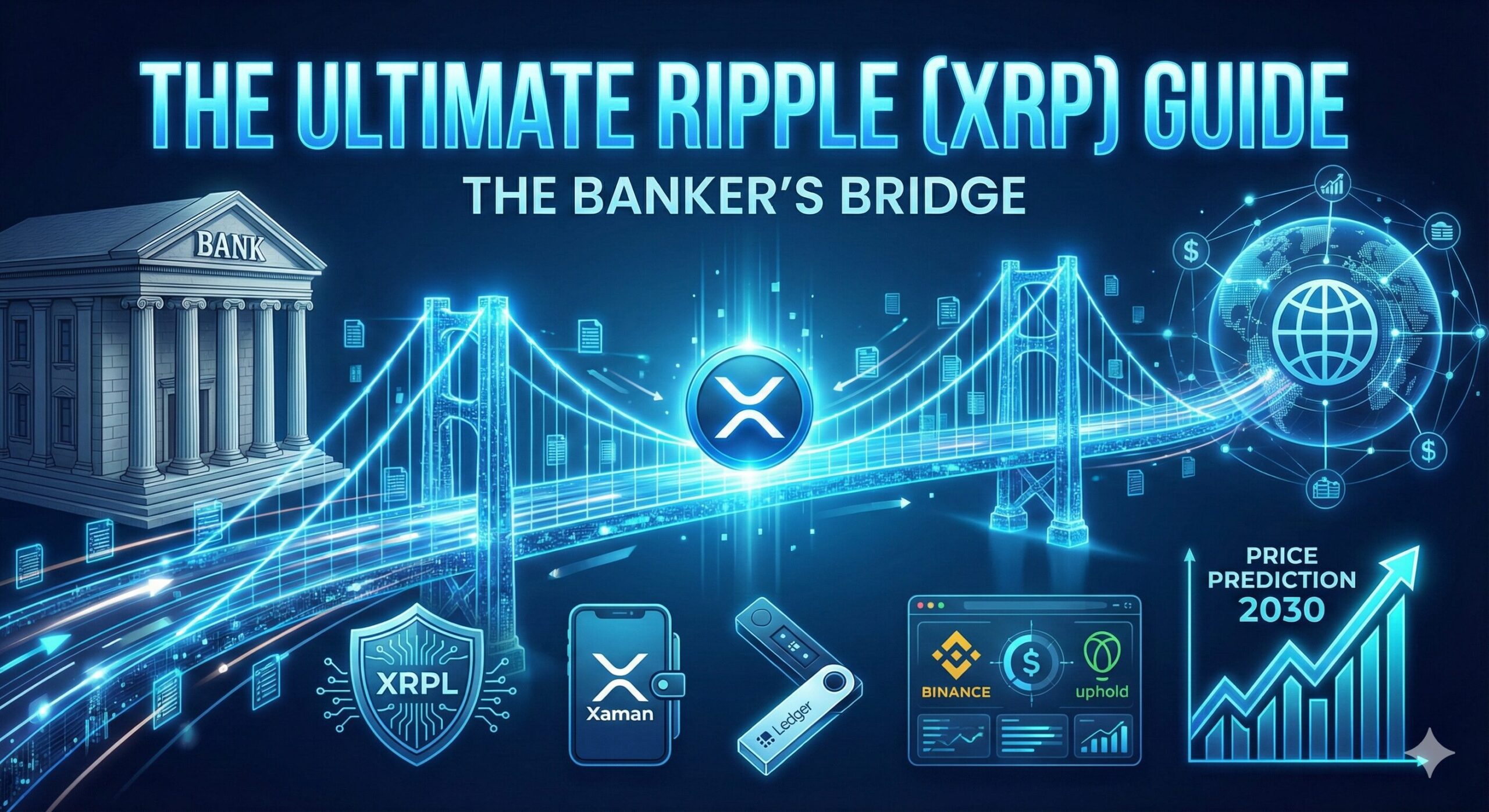
The Ultimate Ripple (XRP) Guide: The Banker’s Bridge
📢 Introduction: The Speed of Money
If Bitcoin is digital gold and Ethereum is digital oil, Ripple (XRP) is a digital bullet train. While the rest of the crypto world was obsessed with replacing banks, Ripple set out to do something perhaps even more ambitious: upgrade them.
For years, XRP has been the most polarizing asset in the industry. It has faced a grueling legal war with the US government, weathered massive delistings, and yet, it remains a top-tier cryptocurrency. Why? Because it solves a trillion-dollar problem: Cross-Border Payments.
In late 2025, the landscape has changed. With legal battles largely in the rearview mirror and institutional adoption ramping up, XRP is no longer just a “gamble”; it is a piece of global financial infrastructure. In this massive Ultimate Ripple (XRP) Guide, we are going to strip away the controversy and look at the tech. We will explain how the XRP Ledger works without miners, where to store your coins so they are safe from exchange collapses, how to earn yield on an asset that (traditionally) had no staking, and where the price could realistically go by 2030.
🔑 Key Takeaways (At a Glance)
Before diving deep, here is a quick summary of what this Ultimate Ripple (XRP) Guide covers:
- Speed & Cost: XRP transactions settle in 3-5 seconds and cost a fraction of a penny ($0.0002).
- Not Mining: XRP does not use Proof of Work or Proof of Stake. It uses the XRPL Consensus Protocol, which is far more energy-efficient.
- The Difference: “Ripple” is the company; “XRP” is the digital asset. They are distinct entities, though deeply connected.
- Passive Income: With the recent AMM (Automated Market Maker) amendment, you can now earn yield on your XRP directly on the ledger.
- Utility: It is used by financial institutions for On-Demand Liquidity (ODL), acting as a bridge currency between fiat currencies (e.g., swapping Dollars to Pesos instantly).
🧠 Part 1: Ripple Technology Explained (The Ledger)
To start this Ultimate Ripple (XRP) Guide, we must first clarify the technology. To understand XRP, you have to forget everything you know about Bitcoin mining. There are no miners. There is no “difficulty adjustment.”
1. The XRP Ledger (XRPL)
The XRP Ledger is an open-source, decentralized blockchain that launched in 2012. It was built for one specific purpose: Payments. Unlike Ethereum, which tries to do everything (gaming, art, finance), XRPL is a specialist. It is designed to move value from Point A to Point B as fast as physics allows.
Because it doesn’t need to run complex smart contracts (historically), it is incredibly lightweight. It can handle 1,500+ transactions per second (TPS) on-chain, and it doesn’t get clogged up when the network is busy like Bitcoin does.
2. The Consensus Protocol (FBA)
How do we agree on who owns what without miners? XRPL uses a Federated Byzantine Agreement (FBA).
- Validators: Instead of miners competing for electricity, the network uses a list of trusted nodes called Validators.
- UNL (Unique Node List): Each server defines a set of other validators it trusts not to collude.
- The Vote: When a transaction happens, these validators vote on its validity. If 80% agree, the transaction is cemented into the ledger.
- Speed: Because this is just a digital vote rather than a complex math puzzle (like Bitcoin), it happens in 3 to 5 seconds.
3. The Bridge Currency (ODL)
This is the “Killer App.” In the traditional banking world (SWIFT), if you want to send money from Japan (JPY) to Brazil (BRL), you usually have to go through US Dollars (USD) first. This takes days and locks up capital. Ripple uses XRP as a Bridge Asset.
- Step 1: Bank A converts JPY to XRP.
- Step 2: XRP is sent across the ledger (3 seconds).
- Step 3: Bank B converts XRP to BRL.
- Result: The money moved instantly, and no one had to hold volatile currency for more than a few seconds.
4. Deflationary Economics
XRP has a maximum supply of 100 Billion tokens.
- No Inflation: All XRP that will ever exist were created at the genesis block. No new XRP are mined.
- The Burn: Every transaction on the network burns a tiny amount of XRP (drops). This is done to prevent spam attacks, but it also makes XRP slightly deflationary over time. As network usage grows, the supply shrinks.
🛒 Part 2: Where to Buy Your First XRP
In this section of our Ultimate Ripple (XRP) Guide, we explore the best gateways to acquire the token. XRP is one of the most liquid assets on earth. Following the legal clarity in the US, it is listed on every major exchange.
1. Binance (The Volume King)
The Vibe: The Global Standard. Binance processes the most XRP volume. If you are a trader looking to buy millions of dollars worth without moving the price, this is where you go.
- Pros: Massive liquidity, supports XRPL deposits/withdrawals, very low fees.
- Cons: Regulatory issues in some Western countries.
2. Uphold (The Loyalist)
The Vibe: The “Ride or Die” Platform. When the SEC sued Ripple and other exchanges delisted XRP out of fear, Uphold famously refused and kept trading open. The XRP community is very loyal to them.
- Pros: extremely easy to use, supports “Anything-to-Anything” trading (e.g., trade Gold directly for XRP).
- Cons: Spreads (fees) can be slightly higher than Binance.
3. Kraken (The Secure Fortress)
The Vibe: Safety First. Kraken is known for its security and banking relationships. It’s a great on-ramp for US and European customers.
- Pros: impeccable security record, great customer support.
- Cons: Interface can be a bit “pro” for total beginners.
4. Direct On-Ledger (DEX)
You can buy XRP directly on the XRPL DEX if you are advanced, but you typically need a “gateway” to get fiat money in first. In 2026, most users still use CEXs (Centralized Exchanges) for their first purchase.
🔒 Part 3: Where to Store Your XRP (Wallets)
A crucial rule in this Ultimate Ripple (XRP) Guide is proper storage. When sending XRP to an exchange, you MUST use a Destination Tag (or Memo).
- The Address: Is like the apartment building (The Exchange).
- The Tag: Is like your specific apartment number. If you forget the tag when sending to Binance/Coinbase, your funds will be lost. (Note: You do not need a tag when sending to your own private wallet).
1. Hardware Wallets (Cold Storage)
For long-term holding (“HODLing”), you need cold storage.
- Ledger Nano X / Stax: Ledger has excellent support for XRP. You can manage your tokens via the “Ledger Live” app. It is widely considered the standard for XRP storage.
- Trezor Model T: Also supports XRP, though historically Ledger has been faster to integrate XRPL features.
- Tangem: The card-shaped wallet is becoming very popular in the XRP community for its ease of use (NFC tapping).
2. Xaman (Formerly Xumm) – The “Must Have”
If you own XRP, you need this app. Xaman is a non-custodial software wallet built specifically for the XRP Ledger.
- Features: It lets you interact with the XRPL ecosystem. You can set up “Trustlines” for other tokens, access the Decentralized Exchange, and sign transactions for apps.
- Security: It turns your phone into a signing device. It is far safer than a standard exchange app because you hold the keys.
💰 Part 4: 5 Proven Ways to Earn XRP
Most readers of this Ultimate Ripple (XRP) Guide want to know how to generate passive income. For years, XRP was a “sterile” asset—it didn’t earn yield. That changed with the AMM Amendment and the rise of XRPL DeFi.
1. AMM Liquidity Provision (The New Standard)
The XRPL now has a native Automated Market Maker (AMM).
- How it works: You deposit your XRP alongside another token (like USDC or a stablecoin) into a liquidity pool on the ledger.
- The Reward: You earn a share of the trading fees from everyone who swaps between those assets.
- Risk: Impermanent Loss (if the price of XRP explodes while pooled, you might have less value than if you just held).
2. Trading (Swing Trading)
XRP is famous for its explosive price movements. It tends to trade sideways (flat) for months and then vertical for weeks.
- Strategy: Traders often play the “XRP Fractal,” buying during the long consolidation periods and selling during the violent pumps.
3. Airdrops (Trustlines)
The XRPL ecosystem uses “Trustlines” to distribute new tokens.
- The Concept: New projects building on XRPL often airdrop free tokens to XRP holders to build a community.
- How to claim: You use the Xaman wallet to “set a trustline” for the specific project. (Warning: Always research the project; while the trustline itself is safe, interacting with scam sites is not).
4. Lending (Nexo / CeFi)
Centralized platforms like Nexo or Ledn allow you to deposit XRP and earn interest.
- Yield: Typically 2% – 5% APY.
- Risk: You are giving custody of your coins to a company. If they go bankrupt (like Celsius/BlockFi did), you lose your XRP. Only do this with highly reputable platforms.
5. Freelancing / Payments
Because XRP is so fast and cheap, it is one of the best currencies for freelancers.
- Bitwage: This service allows you to invoice a client in USD, but get paid directly in XRP. It settles instantly, so you don’t lose money on volatility during the transfer.
🔮 Part 5: XRP Price Prediction 2026 – 2030
This Ultimate Ripple (XRP) Guide analyzes price action based heavily on two things: Regulatory Clarity and Bank Adoption. With the major legal hurdles largely cleared, the “suppression” of the price is gone. The market is now pricing in utility.
The Drivers of Value
- SWIFT Replacement: If XRP captures even 5% of the global SWIFT transaction volume, the daily volume would be in the trillions.
- Stablecoins: Ripple is launching its own stablecoin (RLUSD) on the ledger. This brings massive liquidity and allows institutional money to stay on-chain, increasing the velocity of XRP.
- ETFs: Following Bitcoin and Ethereum, an XRP Spot ETF is widely expected. This would allow pension funds to buy XRP, creating a massive supply shock.
The Prediction Table
| Year | Bear Case (Status Quo) | Base Case (Adoption) | Bull Case (New World Order) |
| 2026 | $1.50 | $3.50 | $5.00 |
| 2028 | $2.50 | $6.00 | $12.00 |
| 2030 | $4.00 | $10.00 | $25.00+ |
Export to Sheets
The Reasoning
- Base Case ($10 by 2030): This assumes Ripple continues to sign up regional banks and remittance firms. XRP becomes a standard “bridge asset” for mid-sized corridors (e.g., Mexico-US, Philippines-Japan). The deflationary burn and steady demand push the price up.
- Bull Case ($25+ by 2030): This is the “CBDC Bridge” scenario. If Central Banks use the XRPL to swap their digital currencies (e.g., Digital Dollar to Digital Euro), XRP becomes the neutral reserve currency of the internet. The volume would be astronomical.
- Bear Case ($4 by 2030): Technology moves fast. If banks decide to build their own private ledgers (like JPM Coin) and ignore public ledgers like XRPL, XRP remains a niche remittance token rather than the global standard.
🏁 Conclusion: The Banker’s Bet
Ripple is not a rebellion against the system; it is an evolution of it.
Investing in XRP is a bet that the future of finance won’t be anarchic, but rather highly efficient, regulated, and digital. It is a bet that banks won’t disappear, but they will upgrade from sending faxes to sending blockchain transactions. We hope this Ultimate Ripple (XRP) Guide has given you the confidence to navigate this ecosystem.
If Bitcoin is for the people, XRP is for the plumbing of the global economy. It isn’t flashy, but if it works, it becomes indispensable.
Your Next Step: If you decide to buy XRP, don’t leave it on the exchange. Download Xaman, move your coins to your own control, and explore the new DeFi ecosystem bubbling up on the ledger.
❓ Frequently Asked Questions (FAQ)
Q: Is the SEC lawsuit over? A: As of late 2025, the major battles regarding XRP’s status as a security are resolved. XRP itself is not a security. There may be lingering appeals regarding specific institutional sales from the past, but the existential threat to the asset is gone.
Q: What is the “Destination Tag” and why do I need it? A: When sending to an exchange (like Binance), the exchange uses ONE big wallet for everyone. The Tag identifies your specific deposit. If you forget it, the exchange gets the money, but they don’t know it’s yours.
Q: Can XRP be mined? A: No. All 100 Billion XRP were created at launch. You cannot mine it with a computer.
Q: What is the difference between Ripple and XRP? A: Ripple is a private software company that builds payment solutions. XRP is the independent digital asset on the open-source XRP Ledger. Ripple holds a lot of XRP, but they do not control the ledger.
Q: Will XRP reach $589? A: This is a popular meme in the community. For XRP to reach $589, its market cap would need to be bigger than the entire global economy. While technically “possible” in a hyper-inflation scenario, a price of $10-$20 is a far more realistic fundamental target for the next decade.