The Ultimate Ethereum Crypto Guide: Where to Buy Ethereum & 2030 Price Prediction
Introduction: The Engine of the Digital Future
If Bitcoin is “Digital Gold”—you know, that scarce, heavy stuff you lock away in a virtual vault to protect your wealth—then Ethereum is “Digital Oil.”
It is the combustible fuel that powers a vast, decentralized supercomputer that anyone in the world can use. It is the liquid energy that makes the new internet run.
As we cruise through late 2025, Ethereum has matured significantly from its chaotic teenage years.
It’s no longer just some science experiment run by geeks in hoodies.
It is the bedrock of Decentralized Finance (DeFi). It is the home of digital ownership (NFTs). And it is the foundation of the entire Web3 internet.
It has successfully transitioned to a green, energy-efficient model. It is now scaling rapidly through high-speed Layer 2 networks.
Owning Ether (ETH), the native asset of the network, is not just holding a currency. It’s like owning a slice of the bandwidth of the internet’s new financial layer. It is an investment in the infrastructure of the future.
In this comprehensive Ethereum crypto guide, we are going to move far beyond the hype and the headlines. We aren’t just going to look at charts.
We are going to look under the hood of this world computer.
We will explain exactly how the machine works. We will show you where to buy Ethereum without paying exorbitant fees. We will teach you how to secure your assets in an unbreakable Ethereum wallet.
And crucially, we will dive deep into the Ethereum price prediction models for the rest of this decade.
Whether you are a complete beginner or a seasoned investor looking to update your thesis for 2026, this Ethereum crypto guide is your roadmap.
Key Takeaways (At a Glance)
Before we dive into the deep dive, here is the cheat sheet for everything you need to know from this Ethereum crypto guide:
- It’s “Digital Oil”: While Bitcoin is a passive store of value, Ethereum is an active utility platform. You need ETH to pay for transactions, making it the fuel of the global decentralized economy.
- Yield Bearing Asset: Unlike Bitcoin, Ethereum works for you. You can earn 3-5% APY just by staking it, acting like a digital bond that pays dividends.
- Deflationary Supply: Through a mechanism called “The Burn” (EIP-1559), when the network is busy, more ETH is destroyed than created. This makes it “Ultra Sound Money.”
- Layer 2 is the Standard: You rarely use the expensive main network anymore. The future is on fast, cheap Layer 2 networks like Base, Arbitrum, and Optimism.
- Institutional Grade: With Spot ETFs live and trading, this Ethereum crypto guide confirms ETH is now a regulated, institutional-grade asset class alongside Bitcoin.
Part 1: Ethereum Technology Explained (The World Computer)
To really get value from this Ethereum crypto guide, you have to stop thinking of ETH as just a coin or a currency.
It is a programmable blockchain.
Bitcoin allows Alice to send money to Bob, which is revolutionary in itself. But Ethereum allows developers to build any application—banking, gaming, social media—without needing a centralized server or a bank.
The Origin Story: Vitalik’s Vision
In 2013, a 19-year-old programmer named Vitalik Buterin realized Bitcoin was too limited.
It was like a calculator—great at math, but it couldn’t run video games or spreadsheets. Vitalik wanted to build a smartphone.
He proposed Ethereum: a blockchain with a built-in programming language. Since launching in 2015, it has grown into a massive ecosystem that handles trillions of dollars in value.
The Core Concept: Smart Contracts
The magic of Ethereum lies in Smart Contracts.
A smart contract is self-executing code deployed on the blockchain. Think of it like a digital vending machine.
- Old Way: You pay a lawyer to hold money in escrow for a house deed. You have to trust the lawyer not to steal the money or lose the paperwork.
- New Way: You send ETH to a smart contract. The code says, “IF the digital deed is transferred to the buyer, THEN automatically release the funds to the seller.”
No lawyer. No middleman. Just code that cannot be bribed.
The Engine: The EVM (Ethereum Virtual Machine)
This all runs on the EVM.
It isn’t one physical server sitting in a basement. It is a global, virtual computer running simultaneously on thousands of nodes (computers) all over the world.
This Ethereum crypto guide emphasizes that this redundancy makes the network unstoppable. If a government shuts down nodes in one country, the rest of the world keeps the computer running.
The Consensus: Proof of Stake (The Merge)
In 2022, Ethereum underwent “The Merge.”
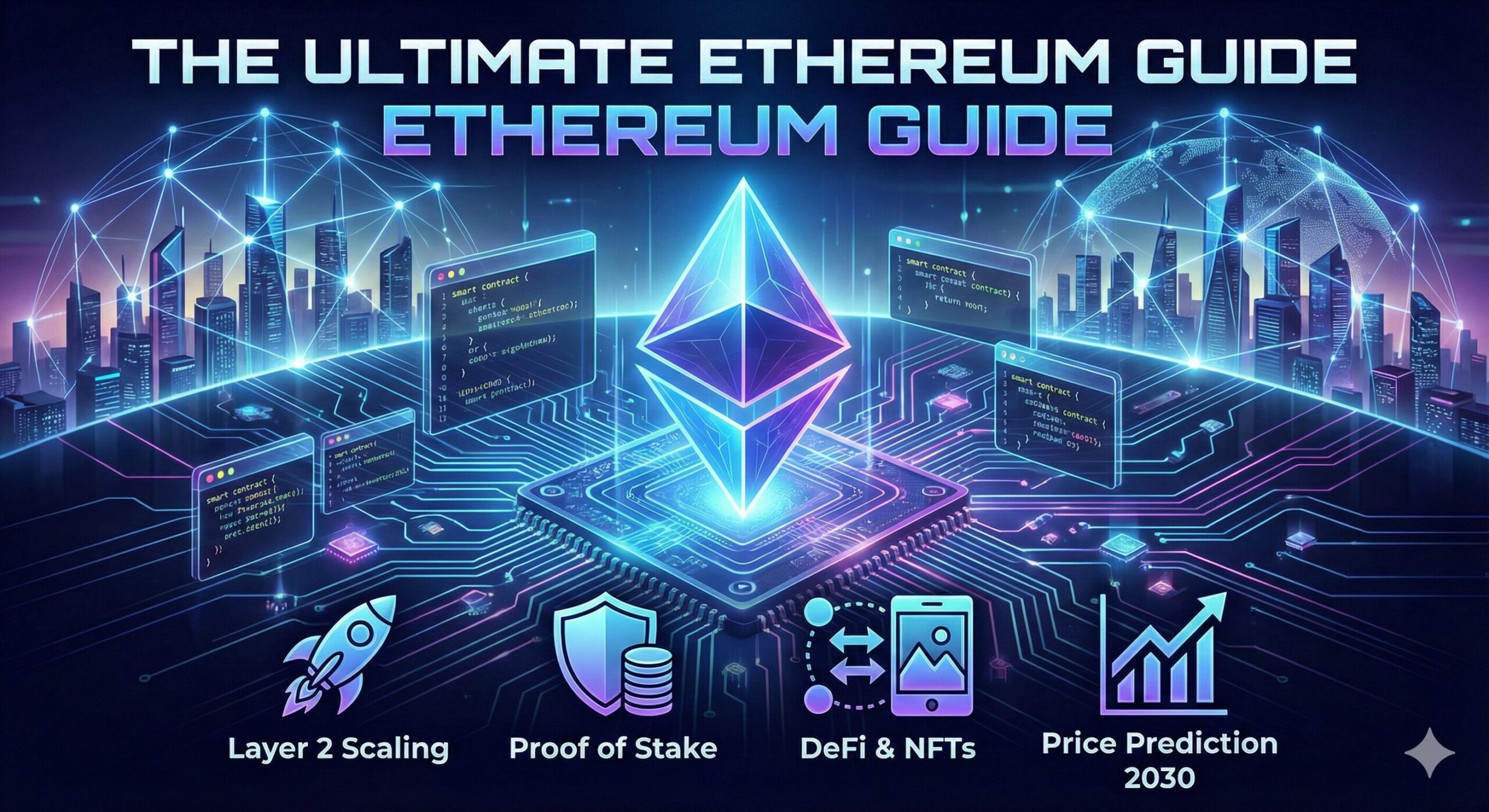
It switched from energy-intensive mining (Proof of Work) to Proof of Stake (PoS).
- No More Miners: We don’t use massive warehouses of computers burning electricity anymore.
- Validators: Now, the network is secured by “Validators” who lock up (stake) 32 ETH. If they process transactions honestly, they earn rewards. If they try to cheat, their staked ETH is slashed (destroyed).
- Why it Matters: This reduced Ethereum’s energy consumption by 99.9%. It is now ESG-friendly and sustainable for the long term. This shift is a huge reason why the long-term Ethereum price prediction remains so bullish.
Scaling: The Layer 2 Revolution
This is the most critical update for 2026. The Ethereum Mainnet (Layer 1) is slow and expensive. It can only handle about 15 transactions per second.
The solution? Layer 2 (L2) Rollups.
Think of Layer 2s like express lanes built on top of the highway. Networks like Arbitrum, Base, and Optimism process thousands of transactions off-chain for pennies.
Then, they bundle them up and post the final result to Ethereum.
- The User Experience: In 2026, you almost never interact with Layer 1. You live on Layer 2, enjoying the security of Ethereum without the $50 gas fees.
Part 2: Where to Buy Ethereum (The On-Ramps)
Since ETH is the second-largest asset in the crypto world, finding where to buy Ethereum is easier than finding a Starbucks.
But not all exchanges are created equal. In 2026, you want platforms that support direct Layer 2 withdrawals to save you money.
1. Centralized Exchanges (CEX) – The Best Starting Point
For most people reading this Ethereum crypto guide, a centralized exchange is the safest and easiest on-ramp. These companies act like brokers; they take your dollars (or Euros/Rupees) and give you crypto.
- Coinbase (Best for USA): Publicly traded and highly regulated. If you are asking where to buy Ethereum for the first time, this is the safest answer. Their “Advanced Trade” mode offers low fees. They also built their own Layer 2 called “Base,” making integration seamless.
- Binance (Best Global): The heavyweight champion. Binance offers the deepest liquidity in the world. If you want to trade huge amounts or access complex financial products, this is the place. It supports withdrawals to almost every Layer 2 network imaginable.
- Bybit (Best for Traders): Known for its slick mobile app and futures trading. A fantastic option for intermediate users.
- Kraken (Best for Security): Famous for never having been hacked. A top choice for European users due to great Euro banking integration.
2. On-Ramp Aggregators (Direct to Wallet)
If you already have a wallet set up, you can use services like MoonPay, Transak, or Ramp.
These mini-apps live inside your wallet and let you buy ETH with a credit card.
- Pros: Fast and convenient.
- Cons: Fees can be high (3-5%). Only use this if you need ETH instantly for a transaction.
3. Decentralized Exchanges (DEXs)
If you are already deep in the crypto ecosystem and hold other tokens (like USDC or Solana), you don’t need a centralized company to tell you where to buy Ethereum.
You just swap for it on a DEX like Uniswap. This is the pure, peer-to-peer way to trade, but it requires you to already have crypto assets.
Part 3: Storing Your ETH: Finding the Best Ethereum Wallet
You wouldn’t buy a solid gold bar and leave it sitting on a park bench.
Similarly, you shouldn’t leave your ETH on an exchange. If the exchange goes bankrupt (remember FTX?), your money is gone.
To truly own your digital assets, you need a dedicated Ethereum wallet.
Hot Wallets (For Spending & Interacting)
These wallets are connected to the internet. You need one of these to log into Web3 apps, play games, or buy NFTs.
- MetaMask: The original. It is the most widely supported Ethereum wallet in the world. It’s a browser extension and a mobile app. It is the standard gateway to the decentralized web.
- Rabby Wallet: A favorite for power users in 2026. Rabby automatically scans transactions for security risks before you sign them. It warns you if a contract looks malicious.
- Rainbow: The most beautifully designed mobile Ethereum wallet. It makes showcasing your NFTs and tracking your portfolio a joy.
Cold Wallets (For Saving & Security)
This Ethereum crypto guide cannot stress this enough: for large amounts (anything you couldn’t afford to lose), get hardware.
A hardware wallet keeps your private keys offline on a physical chip.
- Ledger Nano X / Stax: The industry standard. Ledger devices are battle-tested and integrate with almost every app. The “Stax” model features a curved e-ink screen for a premium experience.
- Trezor Safe 5: Open-source and very secure. Trezor is the original hardware wallet brand and remains a favorite for privacy advocates.
- GridPlus Lattice1: A premium, large-format device for active users who want the highest security without constantly plugging in a USB stick.
The Golden Rule: Use a Hot Wallet for your “walking around money” and a Cold Wallet for your “life savings.”
Using a proper Ethereum wallet ensures that “not your keys, not your crypto” remains a rule you live by.
Part 4: How to Earn Yield (Stacking Wei)
One of the biggest drivers for our positive Ethereum price prediction is that ETH generates cash flow. It’s productive capital.
Unlike gold which sits in a vault doing nothing, Ethereum can work for you.
1. Staking (The Internet Bond)
You can earn roughly 3-4% APY by helping secure the network.
- Solo Staking: Requires 32 ETH and technical hardware. Best for decentralization but hard to do.
- Liquid Staking: Most people use protocols like Lido (stETH) or Rocket Pool (rETH). You deposit any amount of ETH and get a “receipt token” back. This receipt token grows in value over time. You can even use this token in DeFi while it earns rewards.
2. Lending (Be The Bank)
Protocols like Aave and Compound let you lend your ETH or stablecoins to borrowers.
- How it works: You deposit ETH. Someone else borrows it and pays you interest. The protocol guarantees the loan is over-collateralized, so the risk of default is low.
- Returns: Yields fluctuate based on market demand but usually sit between 2% and 5%.
3. Restaking (The 2025 Meta)
A newer concept pioneered by EigenLayer.
- The Concept: You take your already staked ETH (like Lido’s stETH) and stake it again to secure other protocols (like bridges or data layers).
- The Benefit: You earn extra yield on top of your base staking rewards.
- The Risk: It is complex and introduces “slashing” risks from multiple angles. This Ethereum crypto guide recommends this only for advanced users.
Part 5: Ethereum Price Prediction 2026 – 2030
Okay, let’s get to the part everyone scrolls to.
What is the Ethereum price prediction for the next few years? Can it flip Bitcoin? Will it go to zero?
Unlike Bitcoin, which is valued based on pure scarcity, ETH is valued based on usage, yield, and adoption. It acts more like a tech stock that pays dividends (yield) and does share buybacks (burning supply).
The Primary Drivers of Value
- The Burn (EIP-1559): Every transaction fee burns a small amount of ETH. When the network is busy, ETH becomes deflationary. The supply shrinks. Economics 101 says: Lower Supply + Constant Demand = Higher Price.
- Institutional Yield: Wall Street loves yield. Now that they have ETFs, they see ETH as a “digital bond.” They can buy it, hold it, and potentially earn 4% interest (once staking is added to ETFs). This creates massive sticky demand.
- Real World Assets (RWA): The biggest trend of the decade. Stocks, bonds, and real estate are moving on-chain. Ethereum is the settlement layer for this multi-trillion dollar shift.
The Scenarios
2026 Prediction (The Cycle Peak) As the current crypto market cycle reaches its euphoria phase, my Ethereum price prediction sits aggressively around $8,000 – $10,000.
The combination of ETF inflows, Layer 2 maturity, and the supply crunch from “The Burn” creates a perfect storm.
2028 Prediction (The Consolidation) After every cycle comes a correction. However, the floor will be much higher than before.
We expect a stabilization around $12,000 – $15,000 as Ethereum cements itself as the “app store of finance.” The volatility will decrease as the asset class matures.
2030 Prediction (The Global Layer) This is the big one. If Ethereum successfully becomes the global settlement layer for finance, creating a “World Computer” reality, the Ethereum price prediction could skyrocket to $25,000+.
At this price, Ethereum’s market cap would rival today’s tech giants like Microsoft or Apple.
The Bear Case We must be realistic. A bear case Ethereum price prediction would see the asset stagnate around $6,000.
This could happen if regulators crack down hard on DeFi, or if a competitor like Solana completely eats Ethereum’s market share.
However, looking at the developer activity charts for this Ethereum crypto guide, the trend is overwhelmingly up.
Part 6: Risks and Challenges
A responsible Ethereum crypto guide must mention the risks. It isn’t all rainbows and Lamborghinis.
- Smart Contract Risk: Code can have bugs. If a protocol you are using gets hacked, you can lose your funds. Always stick to battle-tested platforms like Aave or Uniswap.
- Regulatory Risk: Governments are still figuring out how to regulate DeFi. Harsh laws could slow down adoption or ban certain privacy tools.
- User Error: There is no “Forgot Password” button in crypto. If you send money to the wrong address or lose your seed phrase, it is gone forever. This is why learning how to use your Ethereum wallet correctly is so vital.
Conclusion: The Foundation of Web3
Bitcoin is the king of money—stoic, unchanging, and solid. But Ethereum is the queen of the internet—dynamic, creative, and expansive.
Ethereum has survived brutal bear markets, internal wars, and massive technical upgrades that would have killed lesser networks.
By shifting to Proof of Stake and embracing a Layer 2-centric roadmap, it has positioned itself as the scalable, secure, and sustainable foundation for the next generation of the internet.
If you made it to the end of this Ethereum crypto guide, you know more than 99% of people on the planet.
You know where to buy Ethereum safely. You know how to secure it in a proper Ethereum wallet. And you understand why the long-term Ethereum price prediction looks so healthy.
Don’t just let your ETH sit there on an exchange. Use it.
Bridge some funds to a Layer 2 like Base. Swap a token on Uniswap. Mint a free NFT. Staking it for yield.
To truly understand the value of this network, you have to be a participant, not just a spectator. The future is open, and it’s being built on Ethereum.
Frequently Asked Questions (FAQ)
Q1: Is it too late to invest according to this Ethereum crypto guide? A: Most analysts say no. We are just leaving the “early adopter” phase and entering the “early majority” phase. As trillion-dollar markets like real estate move on-chain, the demand for ETH generally supports a bullish Ethereum price prediction for the long term.
Q2: What is the best Ethereum wallet for beginners? A: For beginners, a mobile Ethereum wallet like Rainbow or Coinbase Wallet is fantastic because they are user-friendly. If you invest a significant amount (over $1,000), you should upgrade to a hardware Ethereum wallet like a Ledger immediately.
Q3: Where to buy Ethereum with the lowest fees? A: If you are looking for where to buy Ethereum cheaply, avoid the “instant buy” buttons on wallets. Instead, use the “Pro” or “Advanced” trading interfaces on centralized exchanges like Binance, Coinbase, or Kraken. They usually charge 0.1% to 0.4%, compared to 3% on instant buy apps.
Q4: Can the Ethereum price prediction really hit $10,000? A: It is a psychological milestone, but mathematically it is very possible. With the “burn” mechanism reducing supply and institutions buying billions via ETFs, an Ethereum price prediction of $10k is a common target for the peak of this market cycle.
Q5: What is the risk of staking mentioned in this Ethereum crypto guide? A: Staking is generally safe, but not risk-free. You have “slashing” risk (if the validator fails) and smart contract risk (if the liquid staking protocol has a bug). However, for most users reading this Ethereum crypto guide, using a giant protocol like Lido is considered low-risk.
Q6: Does this Ethereum crypto guide recommend Layer 1 or Layer 2? A: Definitely Layer 2. For daily transactions, sending money, or buying NFTs, you should be using networks like Arbitrum, Optimism, or Base. You only use Ethereum Mainnet (Layer 1) for settling large values or secure long-term storage in your Ethereum wallet. Layer 2 is faster and 100x cheaper.