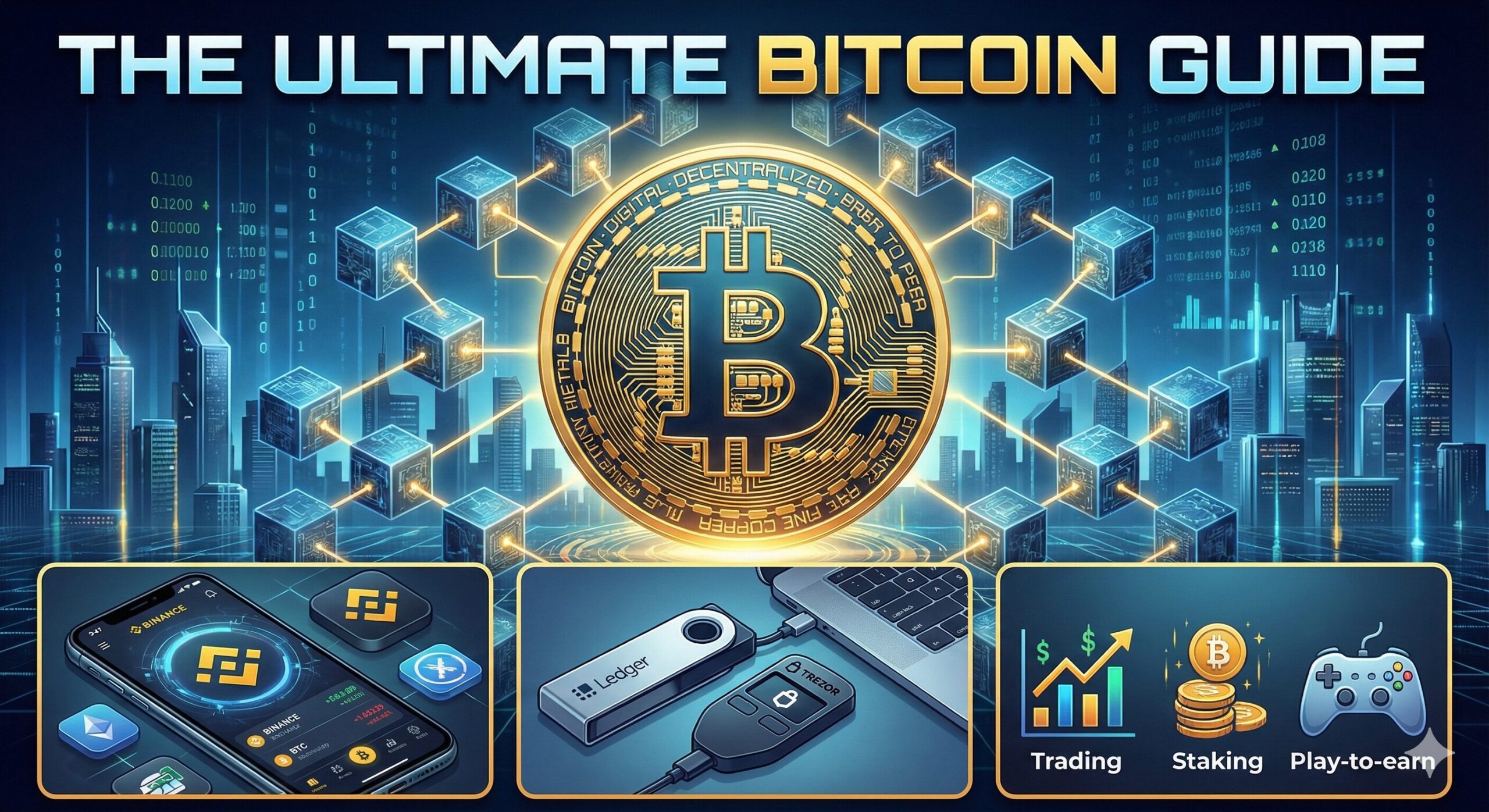
The Ultimate Bitcoin Crypto Guide: Where to Buy Bitcoin & 2030 Price Prediction
Introduction: The Rabbit Hole
So, you’ve decided to take the red pill.
You’ve heard the noise. You’ve seen the headlines about massive price pumps. You’ve seen the panic during crashes. Maybe you’ve even had your cousin tell you to “HODL” while passing the gravy at Thanksgiving dinner.
But what is it, really?
Is it magic internet money? Is it a digital revolution? Or is it just a spreadsheet that people have decided is worth a trillion dollars?
The truth is, it’s a little bit of all those things.
In this comprehensive Bitcoin crypto guide, we are going to strip away the hype. We aren’t going to just stare at price charts and hope for the best.
We are going to look under the hood.
We’ll break down the engine that keeps it running. We will tell you exactly where to buy Bitcoin without getting ripped off. We will teach you how to safely store Bitcoins so no hacker can ever touch them.
And yes, we will dive deep into the massive Bitcoin price prediction models that analysts are building for 2030.
Whether you are a complete beginner holding zero coins or a seasoned trader looking to sharpen your knowledge, this Bitcoin crypto guide is the only resource you will need.
Grab a large coffee. We’re going deep.
Key Takeaways (At a Glance)
Before we dive into the deep dive, here is the cheat sheet for everything you need to know from this Bitcoin crypto guide:
- What is it? A decentralized digital currency that no bank or government controls. It is censorship-resistant and global.
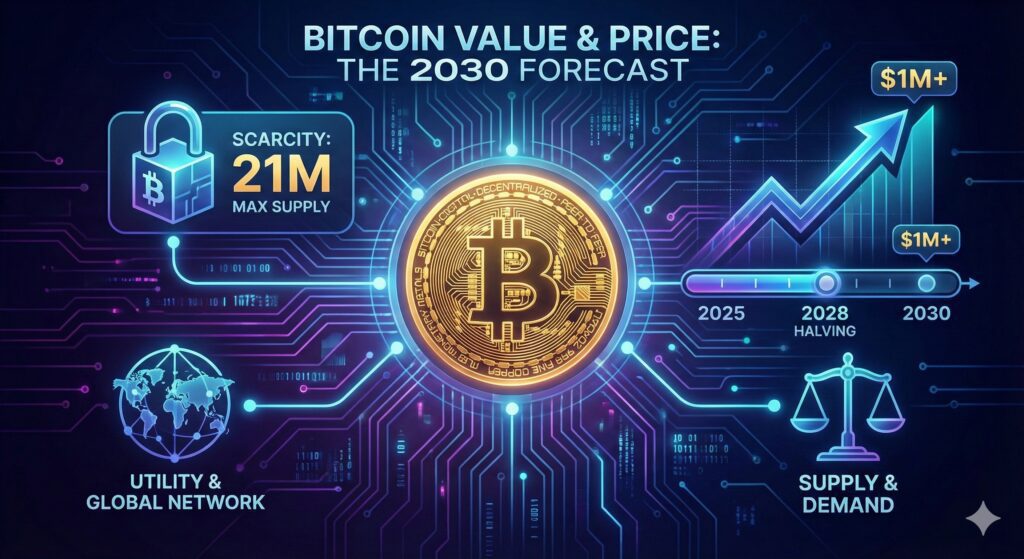
- The Supply Cap: Only 21 million Bitcoins will ever exist. This absolute scarcity is the primary driver behind every bullish Bitcoin price prediction.
- Buying: You need to use trusted exchanges. We will show you where to buy Bitcoin safely (platforms like Binance, Bybit, and Coinbase).
- Security: “Not your keys, not your coins.” To truly own your asset, you must learn to safely store Bitcoins on a hardware wallet.
- The Future: Major financial analysts predict the Bitcoin price prediction could exceed $500,000 or even $1 Million by 2030 due to institutional adoption.
Part 1: Bitcoin Explained (The Deep Dive)
To understand any high-quality Bitcoin crypto guide, you first have to understand the history. Why does this thing even exist?
The Origin Story: 2008
To understand Bitcoin, look at the world in 2008.
The global financial system was melting down. Banks were gambling with people’s money. Governments were bailing them out by printing billions of dollars.
Trust in centralized institutions was at an all-time low.
On October 31, 2008, a mysterious figure (or group) named Satoshi Nakamoto published a whitepaper.
It was titled: “Bitcoin: A Peer-to-Peer Electronic Cash System.”
Satoshi didn’t just invent a new currency. He solved a computer science problem that had stumped experts for decades: The Double-Spend Problem.
Before Bitcoin, if I sent you a digital file (like an MP3), I still had a copy of it.
You can’t have a currency if I can spend a digital dollar and still keep it to spend again. Banks solve this by keeping a central ledger.
Satoshi solved it by giving the ledger to everyone.
On January 3, 2009, Satoshi mined the “Genesis Block,” and the network was born. This foundation is crucial to understanding the rest of this Bitcoin crypto guide.
The Technology: How It Actually Works
Let’s get technical, but let’s keep it simple.
As we dive deeper into this Bitcoin crypto guide, remember that Bitcoin isn’t a physical coin. It is a history of transactions stored on a Blockchain.
1. The Blockchain (The Public Ledger)
Imagine a Google Sheet that everyone in the world can view. However, no one can delete a row from it.
You can only add rows. These rows are transactions.
2. Blocks
Think of these as pages in a record book. Every 10 minutes (on average), a new page (Block) is filled with recent transactions.
3. The Chain
Each new page contains a unique digital fingerprint (hash) of the previous page.
This links them together chronologically. If you try to rip out page 10, page 11 no longer makes sense because the fingerprint doesn’t match.
This makes the history immutable (unchangeable).
4. Decentralization
There is no “Bitcoin HQ.” There is no server room.
The network is run by thousands of computers scattered around the world, called Nodes.
If someone tries to spend Bitcoin they don’t have, the Nodes reject the transaction. Because there are thousands of copies of the ledger, you can’t hack Bitcoin unless you hack thousands of computers simultaneously across the globe.
Proof of Work (The Security Guard)
This is the genius part. How do we agree on which “page” of transactions is the real one?
We use a consensus mechanism called Proof of Work (PoW).
Miners use specialized computers to solve complex math puzzles. The miner who solves the puzzle first gets to add the next block. They are rewarded with brand new Bitcoin.
This energy usage creates a “digital wall” of energy that protects the network from attacks.
It is this immense security that allows you to safely store Bitcoins on the network without fear of the bank freezing your account.
The Monetary Policy: Why It’s Valuable
The technology is cool, but the economics are why people buy it. A key component of this Bitcoin crypto guide is explaining scarcity.
Hard Cap (21 Million)
There will never be more than 21,000,000 Bitcoins. Ever.
This makes it absolutely scarce. Unlike fiat currency (Dollars, Euros, Rupees), which governments can print infinitely, Bitcoin is deflationary by design.
The Halving
Every 4 years, the reward that miners get is cut in half.
This creates a “supply shock.”
If demand stays the same but the incoming supply drops, the price usually goes up. This cycle is what fuels the long-term Bitcoin price prediction.
Part 2: Bitcoin Price History (The Rollercoaster)
To understand where we are going, we have to look at where we’ve been.
Bitcoin has historically moved in 4-year cycles centered around the “Halving” events. This history helps inform every Bitcoin crypto guide and its outlook.
- 2009 ($0.00): Bitcoin launched. It was technically worthless. It was just magic internet money for geeks.
- 2011 ($1.00): Parity with the US Dollar. A historic psychological moment.
- 2013 ($1,100): The first major bubble. Bitcoin gained mainstream news coverage, then crashed 80%.
- 2017 ($19,700): The retail mania. Everyone’s taxi driver and barber was talking about BTC. ICOs were booming.
- 2018 ($3,200): “Crypto Winter.” The bubble popped, and prices crashed 80% again. The media declared Bitcoin dead.
- 2021 ($69,000): The institutional run. Companies like Tesla and MicroStrategy bought in. El Salvador made it legal tender.
- 2022 ($15,500): The collapse of FTX and global inflation fears drove prices down.
- 2024 ($73,000+): The “Spot ETF” era begins. Wall Street officially enters the chat with BlackRock and Fidelity launching products.
This consistent pattern of “higher highs” and “higher lows” is the strongest argument for a bullish Bitcoin price prediction.
Part 3: Bitcoin Price Prediction 2026 – 2030
Everyone wants to know: “Am I too late?”
Based on data from major financial firms like Ark Invest, Standard Chartered, and VanEck, here is the consensus Bitcoin price prediction for the remainder of the decade.
The Prediction Table
| Year | Bear Case (Stagnation) | Base Case (Adoption) | Bull Case (Global Reserve) |
| 2026 | $85,000 | $150,000 | $220,000 |
| 2028 | $120,000 | $250,000 | $450,000 |
| 2030 | $200,000 | $550,000 | $1,000,000+ |
The “Why” Behind the Numbers
Why do experts cited in this Bitcoin crypto guide think the price could hit $1 million? It seems crazy, right?
Here is the logic:
1. Spot ETFs
In 2024, the US approved Spot ETFs. This allows massive pension funds and retirement accounts to buy Bitcoin as easily as they buy Apple stock.
This wall of money is just getting started. It provides a constant buying pressure that supports a higher Bitcoin price prediction.
2. Corporate Treasuries
Companies like MicroStrategy hold billions in Bitcoin.
If other S&P 500 companies decide to put just 1% of their cash reserves into BTC to protect against inflation, the supply shock would be massive.
3. Digital Gold
Gold has a market cap of roughly $13 Trillion. Bitcoin is currently under $2 Trillion.
If Bitcoin catches up to gold (as the digital version), the price per coin would need to be over $600,000.
4. The 2028 Halving
The next supply cut will happen in 2028. This will make Bitcoin even scarcer than gold.
Historically, the year after a halving is always bullish for the Bitcoin price prediction.
Part 4: Where to Buy Bitcoin (Exchange Reviews)
You understand the tech and the potential from this Bitcoin crypto guide.
Now you want skin in the game. But where do you go? You need a Crypto Exchange.
In this section of our Bitcoin crypto guide, we cover the top contenders to help you decide where to buy Bitcoin.
1. Binance (The Juggernaut)
- The Vibe: The Amazon of Crypto. Binance is the largest exchange in the world. If you are looking for deep liquidity, this is the place.
- Pros: Massive P2P market (great for restricted banking regions), very low fees (0.1%), and tons of features like Earn and Launchpad.
- Cons: The dashboard is complex and can overwhelm beginners.
- Verdict: The best answer for where to buy Bitcoin if you want low fees and high volume.
2. Bybit (The Trader’s Paradise)
- The Vibe: Sleek, Fast, Professional. Originally famous for futures trading, Bybit is now a fantastic all-rounder with a buttery smooth app.
- Pros: Great user experience, excellent welcome bonuses, and a very polished “One-Click Buy” system.
- Cons: Fewer “tiny cap” coins than Binance.
- Verdict: A fantastic option for where to buy Bitcoin if you appreciate a good mobile app.
3. KuCoin (The People’s Exchange)
- The Vibe: The Altcoin Hunter’s Den. KuCoin is where people go to find “gems” early.
- Pros: Access to rare coins and built-in trading bots (Grid/DCA) that are free to use.
- Cons: They suffered a hack in 2020 (though funds were recovered), reminding users to be cautious.
- Verdict: A solid choice for where to buy Bitcoin if you also want to explore altcoins.
4. Coinbase (The Beginner’s Choice)
- The Vibe: The Apple of Crypto. Clean, simple, and very regulated (publicly traded in the US).
- Pros: Extremely easy to use. Great educational rewards.
- Cons: Higher fees than Binance or Bybit unless you use their “Advanced” mode.
- Verdict: The safest answer for where to buy Bitcoin for total newbies in the USA.
Part 5: How to Safely Store Bitcoins (Wallets Explained)
There is a saying in crypto that you need to tattoo on your brain: “Not Your Keys, Not Your Coins.”
When you keep your funds on an exchange, you are essentially asking them to hold your money for you. If they go bankrupt (like FTX did), your money is gone.
To prevent this, this Bitcoin crypto guide insists you use a wallet.
Type 1: Hot Wallets (Convenient but Less Secure)
Hot wallets are connected to the internet. They are free apps you download on your phone or browser.
- Examples: Trust Wallet, Exodus, MetaMask.
- Use Case: Great for small amounts of spending money, but because they are online, they are vulnerable to malware.
- Risk: They are not the best way to safely store Bitcoins for the long term.
Type 2: Hardware Wallets (The Gold Standard)
This is the focus of the security section of this Bitcoin crypto guide.
A hardware wallet (or Cold Wallet) is a physical device that stores your private keys offline. It looks like a USB drive.
Even if you plug it into a virus-infected computer, your keys remain safe inside the device. This is the only way to safely store Bitcoins with 100% confidence.
1. Ledger (The Industry Leader)
Ledger is the most popular brand globally. Their devices use a “Secure Element” chip to protect your keys.
- Ledger Nano S Plus: The budget king. Perfect for pure security.
- Ledger Nano X: Has Bluetooth for mobile use.
- Verdict: A top-tier choice to safely store Bitcoins.
2. Trezor (The Open-Source Hero)
Trezor was the first hardware wallet ever made. Their philosophy is “Open Source,” meaning their code is public.
- Trezor Model One: The classic. Affordable and reliable.
- Trezor Safe 3: The modern successor with better security chips.
- Verdict: Perfect if you want to safely store Bitcoins with total transparency.
3. Tangem (The Card Wallet)
Tangem looks like a thick credit card. You just tap it against your phone to sign transactions. It’s incredibly easy to use, though some purists prefer the screen of a Ledger.
4. Coldcard (The Bitcoin Maximalist)
If you only care about Bitcoin and want military-grade security, look at the Coldcard.
It is “air-gapped,” meaning you never have to plug it into a computer. It is the ultimate way to safely store Bitcoins.
Part 6: 8 Proven Ways to Earn Crypto in 2026
You’ve bought some, you’ve stored it. Now, how do you get more?
This Bitcoin crypto guide isn’t just about holding; it’s about growing your stack.
- Spot Trading: The classic “Buy Low, Sell High.” You buy Bitcoin when the market is fearful and sell when the market is greedy.
- Staking: For coins like Ethereum or Solana, you can lock them up to earn yield (3-7% APY). Bitcoin itself doesn’t have staking, but you can “wrap” it to use in DeFi (risky!).
- Crypto Lending: You can lend your assets to borrowers on platforms like Aave or Ledn. Be careful, as this introduces risk.
- Play-to-Earn Gaming: In 2026, video games pay you. Games like Illuvium or Pixels allow you to earn tokens by playing.
- Airdrop Hunting: New projects need users. To attract them, they give away free tokens to early adopters. This can be lucrative.
- Freelancing for Crypto: This is the most reliable method in this Bitcoin crypto guide. Work for Bitcoin. Platforms like LaborX connect freelancers with clients paying in crypto.
- Learn-to-Earn: Exchanges like Coinbase pay you small amounts ($1-$5) for watching educational videos.
- Affiliate Marketing: If you have a blog, refer friends to the exchanges where you learned where to buy Bitcoin. You earn a commission on their trading fees.
Part 7: Risks and Common Mistakes
A responsible Bitcoin crypto guide must talk about the dangers. The Bitcoin price prediction is bullish, but the road is bumpy.
1. Panic Selling
When Bitcoin drops 20% in a week, your instinct will be to sell. Don’t.
Volatility is the price of admission. If you believe in the long-term Bitcoin price prediction, these dips are buying opportunities, not exit signals.
2. Falling for Scams
If someone on Telegram promises to “double your Bitcoin,” it is a scam. If a celebrity is “giving away crypto,” it is a scam.
Never send your Bitcoin to anyone expecting a return.
3. Losing Your Seed Phrase
This is the only way to recover your wallet if you lose the device. If you lose this paper, your money is gone forever.
To safely store Bitcoins, write this phrase down on paper (or metal) and hide it. Never type it into a computer or take a photo of it.
4. Leaving Coins on Exchanges
We’ve said it before in this Bitcoin crypto guide, but it bears repeating:
Exchanges are for trading. Wallets are for saving.
Once you decide where to buy Bitcoin and make the purchase, move it to cold storage immediately.
Conclusion: The Long Game
Bitcoin is more than just an investment. It is a shift in how we view value.
It is the first time in history that humans have a property right that cannot be diluted by a king or seized by a bank (if secured properly).
The price will crash, and the media will declare “Bitcoin is Dead” for the 500th time.
But the blocks will keep producing. The supply will keep getting scarcer. We hope this Bitcoin crypto guide has given you the confidence to take your first steps.
The Bitcoin price prediction looks incredible for the next decade. But remember, volatility is the price you pay for performance.
Your Next Step:
- Decide where to buy Bitcoin (start small!).
- Move it to a hardware wallet to safely store Bitcoins.
- HODL.
Don’t try to buy 1 whole Bitcoin today (unless you can afford it!). Start small. Buy $50 worth.
Once you see the transaction confirm on the blockchain without a bank’s permission, you’ll understand why this Bitcoin crypto guide calls it the future of money.
Frequently Asked Questions (FAQ)
Q: Is it too late to buy Bitcoin in 2026?
A: Most analysts believe we are still in the “early majority” phase. With a Bitcoin price prediction of $1 Million by 2030, this Bitcoin crypto guide suggests that buying now could still offer significant returns compared to traditional stocks.
Q: Can I buy less than 1 Bitcoin?
A: Yes! You can buy 0.00000001 BTC. The smallest unit is called a “Satoshi.” You can buy $10 worth easily once you know where to buy Bitcoin.
Q: What happens if I lose my hardware wallet?
A: As long as you have your Seed Phrase (the 12-24 words you wrote down), you can buy a new device and restore your funds. This backup is the secret to how you safely store Bitcoins.
Q: Is Bitcoin legal?
A: In most major economies (USA, UK, Europe, India, Japan), Bitcoin is legal to buy and trade. It is usually taxed as property. Always check your local laws.
Q: Why does the price change so much?
A: Bitcoin is still a relatively small asset class compared to Gold. This means large orders can move the price. As the market grows, this volatility is expected to decrease, stabilizing the Bitcoin price prediction.
Q: What is the best resource to learn more?
A: A comprehensive Bitcoin crypto guide like this one! Bookmark us and stay updated on the market trends.