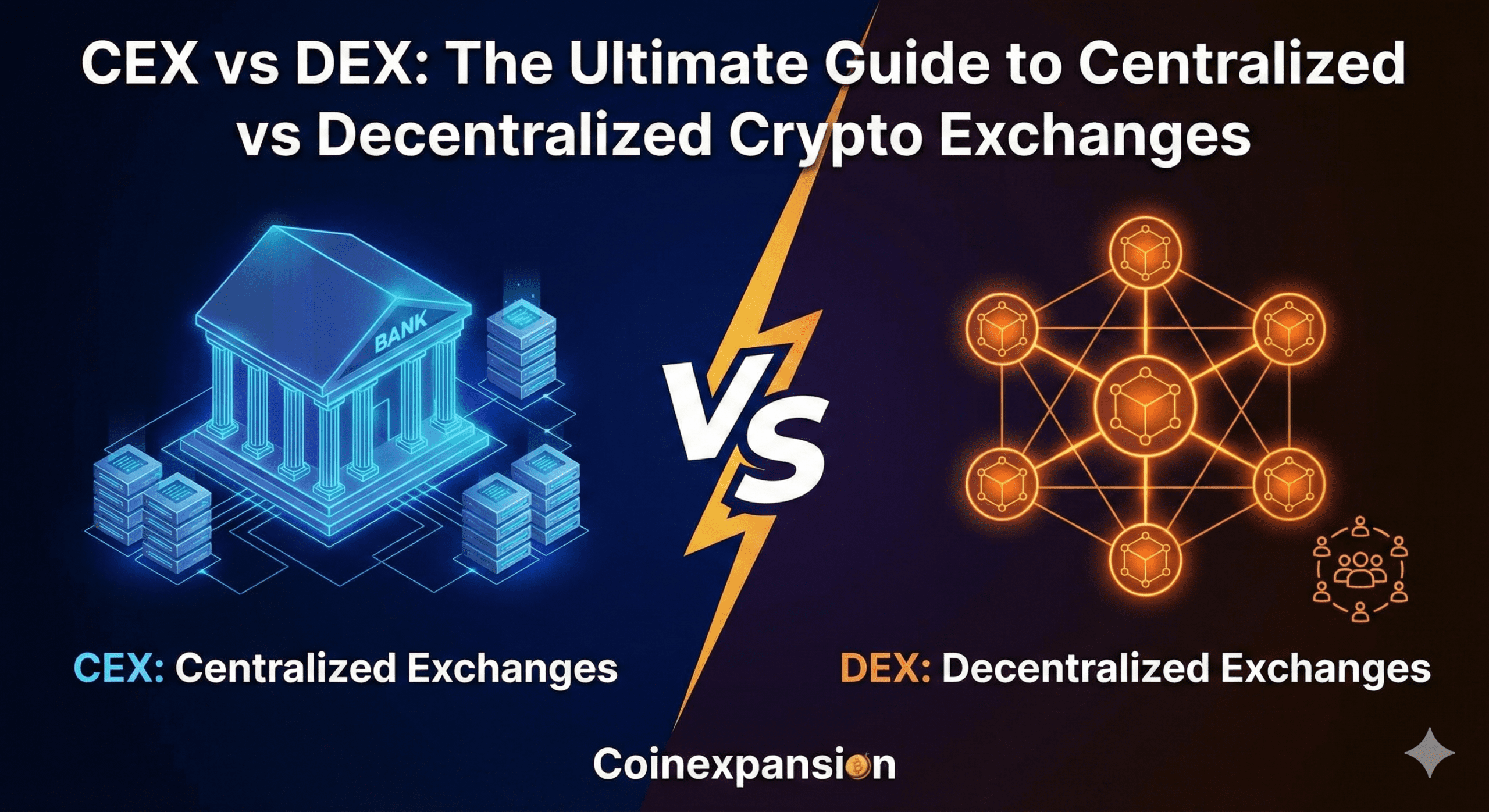
CEX vs DEX: The Ultimate Guide to Centralized vs Decentralized Crypto Exchanges
So, picture this: I remember when I first bought Bitcoin back in the day. I was sweating bullets, staring at this clunky website, terrified I’d press the wrong button and send my money into the void. It felt like trying to fly a spaceship without a manual. That’s why understanding the battle of cex vs dex is so crucial; it’s basically deciding whether you want a bank to hold your hand or if you want to be your own bank and carry the vault keys yourself.
We’re going to break this down simply. Whether you’re here to trade the next big meme coin or just stack some ETH, knowing the difference between centralized vs decentralized crypto exchanges is going to save you a lot of headaches (and probably some fees). Let’s dive in.
Key Takeaways
- Custody is the Dealbreaker: The most critical difference in cex vs dex is custody. CEX holds your keys; DEX lets you hold them. If you can’t tolerate the risk of losing your own keys, stick to CEX.
- Fiat vs. Crypto: CEXs are your gateway from the bank to the blockchain. Cex accepts a multitude of payment methods or the option to deposit Fiats whereas DEXs are for when you are already inside the crypto economy.
- The Fees Trap: Don’t just look at trading fees. In the centralized vs decentralized crypto exchanges comparison, network fees (gas) on DEXs can sometimes cost more than the trade itself on chains like Ethereum. Whereas there are Centralised crypto exchanges that charge almost zero fees for trading spot and futures.
- Security Nuance: CEXs risk institutional failure (bankruptcy). DEXs risk code failure (hacks). Diversifying between both is often the smartest play.
- Feature Set: If you need high leverage, loans, or fiat off-ramps, the CEX wins. If you need privacy and access to unlisted tokens, the DEX wins.
The Great Comparison: CEX vs DEX
Alright, let’s get into the nitty-gritty. This is the heavy-lifting part of the guide, where we really tear apart the cex vs dex debate so you can figure out which corner is right for you. It’s kinda like choosing between an iPhone and a custom-built Linux PC. One just works out of the box, and the other gives you god-mode power but might crash if you look at it wrong.
1. Interface and User Experience
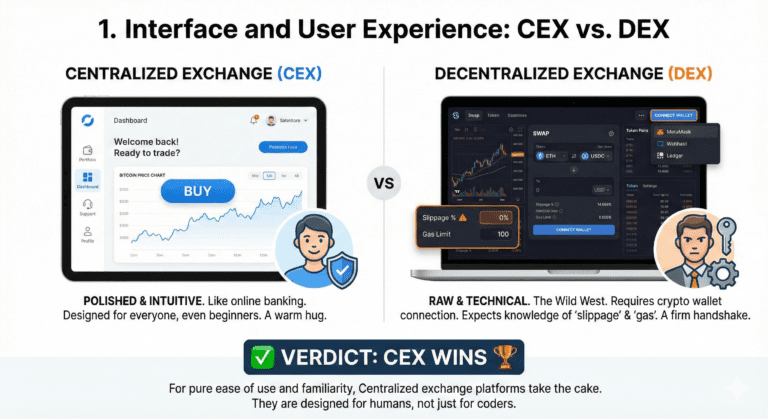
When you first sign up for a Centralized Exchange (CEX), it feels familiar. It’s like logging into your online banking or PayPal. You’ve got a dashboard, a clear “Buy” button, and probably some nice charts that don’t look too scary.
These platforms spend millions on UX designers to make sure your grandma can figure out how to buy Crypto instantly. The interface is polished, intuitive, and designed to keep you from making mistakes.
On the flip side, diving into a Decentralized Exchange (DEX) can feel a bit like the Wild West. When you compare centralized vs decentralized crypto exchanges, the interface on a DEX is usually stripped down. You connect your crypto wallet (like MetaMask or Ledger), and boom, you’re in.
There’s no greeting, no “forgot password” link. It’s raw. While modern DEXs like Jupiter or Uniswap have gotten way better, they still expect you to know what “slippage” and “gas limits” are. If you’re a beginner, a CEX is a warm hug; a DEX is a firm handshake.
Verdict: CEX Wins. For pure ease of use and familiarity, Centralized exchange platforms take the cake. They are designed for humans, not just for coders.
2. Trading Types and Features
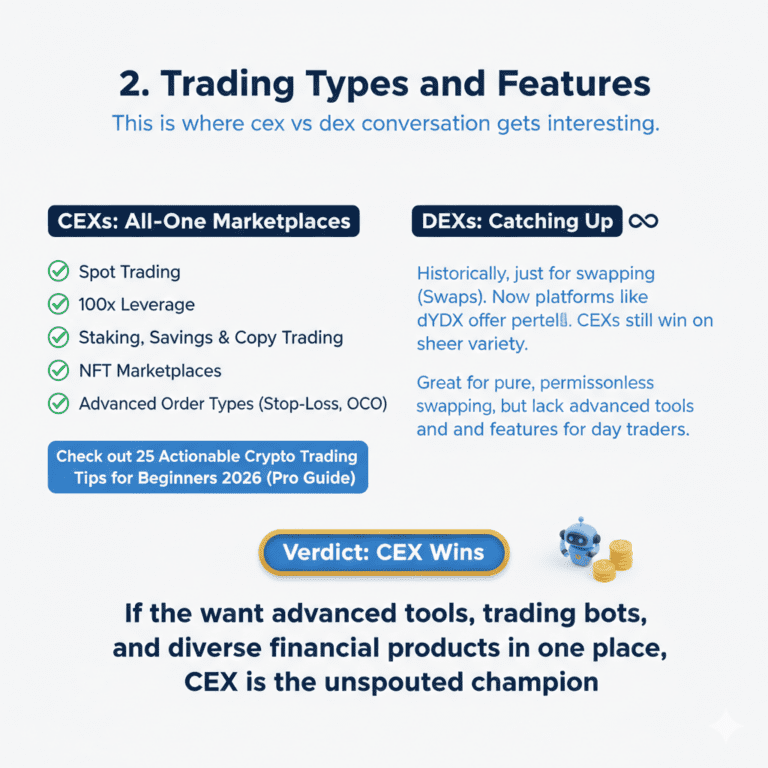
This is where the cex vs dex conversation gets interesting. CEXs are basically the all-in-one crypto marketplace. You want spot trading? Got it. Futures with 100x leverage? Sure.
Staking, savings accounts, copy trading, and even NFT marketplaces? It’s all under one roof. They offer advanced order types like Stop-Loss and OCO (One Cancels the Other), which are lifesavers for risk management.
DEXs are catching up, though. Historically, they were just for swapping one coin for another (Swaps). But now, platforms like dYdX allow for perpetual trading on-chain. However, in the general centralized vs decentralized crypto exchanges landscape, CEXs still win on sheer variety of features.
If you want to automate your trades with a grid bot or borrow cash against your crypto, a centralized platform is usually the easier route. DEXs are amazing for pure, permissionless swapping, but they can lack those fancy bells and whistles that active day traders love on CEXs.
Verdict: CEX Wins. If you want advanced tools, trading bots, and diverse financial products in one place, CEX is the undisputed champion.
3. Number of Coins Supported
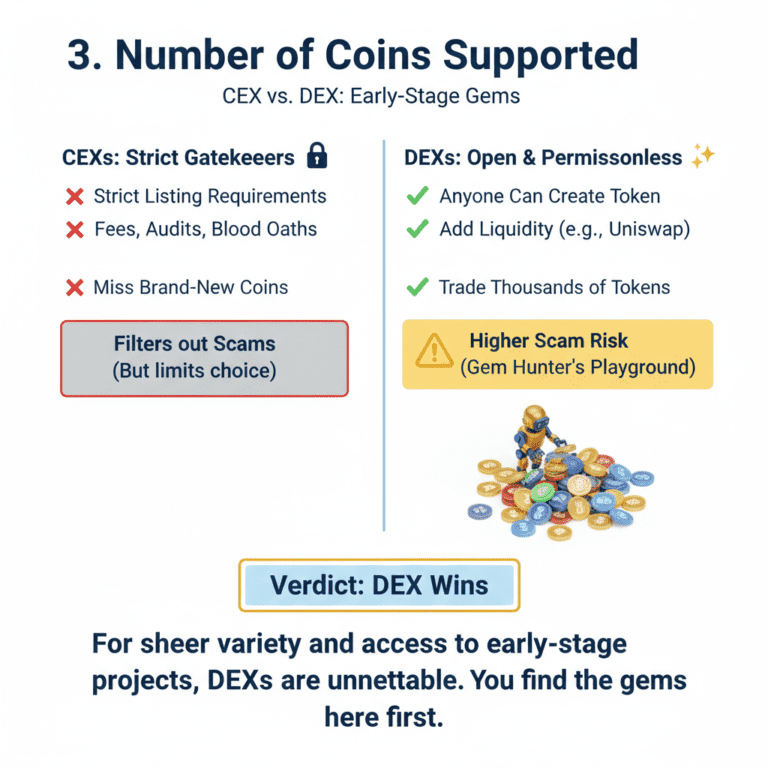
Here’s a fun fact: CEXs are gatekeepers. They have strict listing requirements. A project has to pay fees, pass audits, and sometimes sign blood oaths to get listed on Binance or ByBit. This filters out a lot of scams, but it also means you might miss out on that brand-new coin that just launched 10 minutes ago.
This is where the cex vs dex dynamic shifts. DEXs are permissionless. Anyone, literally anyone, can create a token and add liquidity to a DEX like Uniswap or Raydium. This means you can trade thousands of tokens that will never see the light of day on a CEX.
But, and this is a big “but,” it also means the risk of buying a scam token is way higher. If you’re a “gem hunter” looking for 1000x gains on obscure coins, centralized vs decentralized crypto exchanges simply can’t compare. DEXs are your playground.
Verdict: DEX Wins. For sheer variety and access to early-stage projects, DEXs are unbeatable. You find the gems here first.
4. Fee Structure
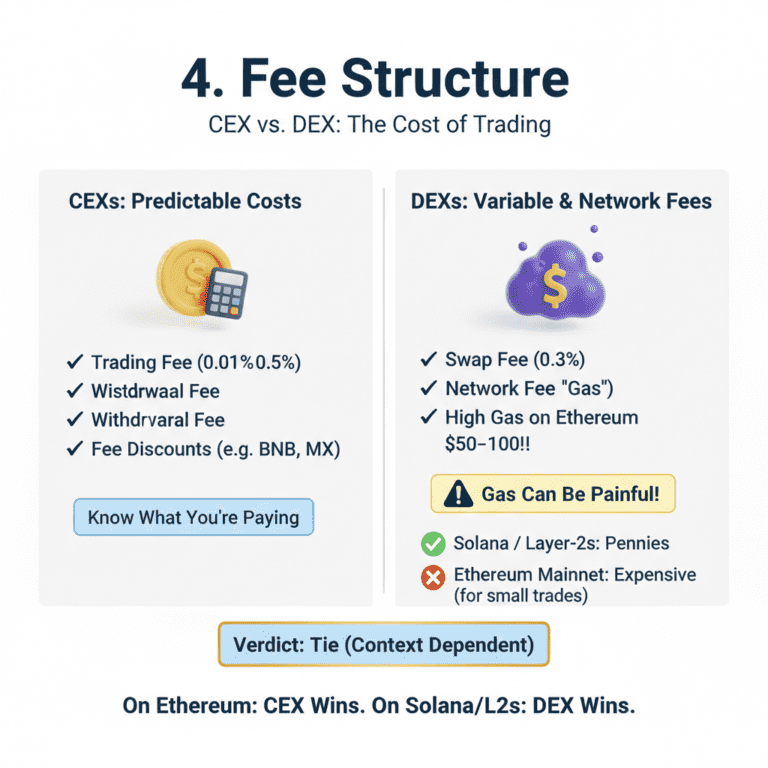
Let’s talk money. Nobody likes fees, right? CEXs usually charge a trading fee (often between 0.01% to 0.5%) and a withdrawal fee. It’s straightforward. You know what you’re paying.
Some are even no-fee crypto exchanges, and some exchanges offer fee discounts if you hold their native token (like BNB or KCS).
DEXs are a different beast. You pay a small swap fee (usually 0.3%), which goes to liquidity providers, but the real killer can be the network fee, or “gas.” If you’re trading on Ethereum during a bull run, a single swap might cost you $50 or $100 in gas. It’s painful.
However, if you use Layer-2 solutions or chains like Solana, the fees are pennies. So, when analyzing cex vs dex, the winner in fees really depends on which blockchain you are using. On Solana? DEX wins. On Ethereum mainnet? CEX might be cheaper for small amounts.
Verdict: Tie (Context Dependent). If you trade on Ethereum, CEX wins on cost. If you trade on Solana or Layer-2s, DEX is often cheaper.
5. Payment Methods Supported
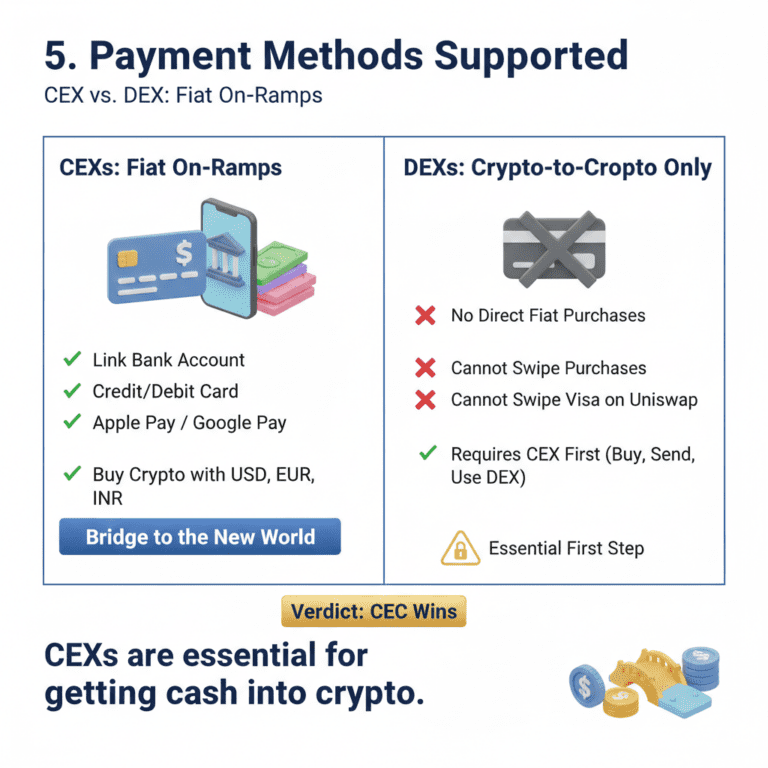
This is usually the dealbreaker for new users. Centralized vs decentralized crypto exchanges have a massive difference here: Fiat.
CEXs have “Fiat On-Ramps.” This means you can link your bank account, use a credit card, or even use Apple Pay to buy crypto directly with Dollars, Euros, or Rupees. It is the bridge between the old world and the new world.
DEXs generally don’t touch fiat money. They deal strictly in crypto. You can’t just swipe your Visa on Uniswap to buy ETH (usually). You have to buy crypto on a CEX first, send it to your wallet, and then use the DEX. So, for getting your money into the market, CEXs are essential. This is a key point in the cex vs dex debate. DEXs are for crypto-to-crypto, while CEXs are for cash-to-crypto.
Verdict: CEX Wins. You simply cannot easily use a DEX without first using a CEX or a ramp service to get your crypto.
6. Privacy and KYC
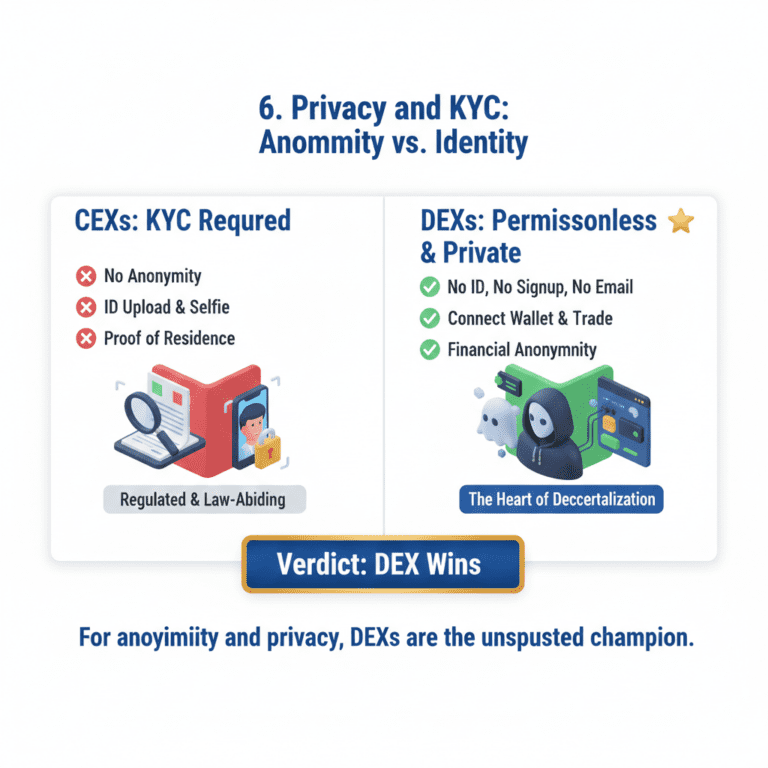
I care a lot about privacy, and maybe you do too. CEXs are regulated businesses. They require KYC (Know Your Customer). You have to upload your ID, take a selfie, and prove you live where you say you live.
It’s kinda annoying, but it’s the law in most places. If you want to stay off the grid, a CEX is not your friend. However, there are a few no kyc crypto exchanges appeared in the last few years in the cryptocurrency exchange industry.
DEXs? They don’t care who you are. No ID, no signup, no email. You just connect your wallet and start your crypto trading journey. This privacy is the heart of the centralized vs decentralized crypto exchanges philosophy. It’s about financial freedom and anonymity. If you value keeping your identity separate from your trading activity, the cex vs dex choice is obvious: you go decentralized every time.
Verdict: DEX Wins. No contest here. If you want anonymity and privacy, DEX is the only way to go.
7. Security: Custody vs Smart Contracts
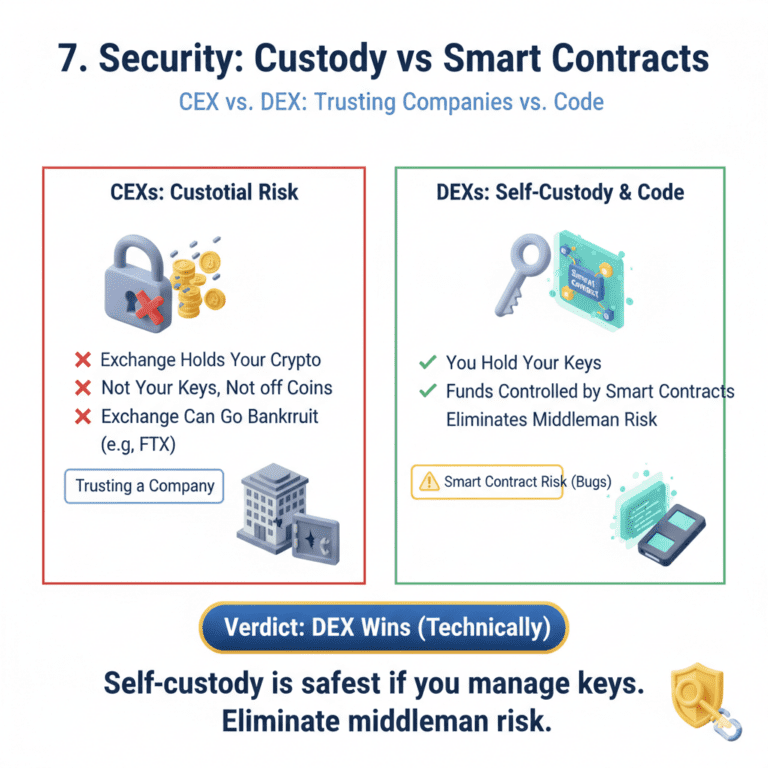
This is the scary part. With a CEX, you don’t actually own your crypto. The exchange holds it for you. If the exchange goes bankrupt (remember FTX?), your money is gone. Poof. “Not your keys, not your coins” is the mantra here. However, now major CEXs have insurance funds and top-tier security teams.
On a DEX, you hold the keys. The exchange never touches your funds; smart contracts do the swapping. This protects you from a CEO running away with your money, but it introduces “Smart Contract Risk.” If there is a bug in the code, hackers can drain the liquidity pools. So, when weighing cex vs dex, you’re choosing between trusting a company (CEX) or trusting code (DEX). For me? I trust code, but I verify it first.
Verdict: DEX Wins (Technically). Self-custody is the safest method if you know how to manage your keys. You eliminate the “middleman risk.”
8. Customer Support

Ever tried to call Bitcoin’s customer support? Yeah, it doesn’t exist. That’s the DEX experience. If you send money to the wrong crypto address or get stuck, you’re on your own. Maybe you can ask in a Discord channel, but that’s it.
CEXs have actual support teams. Live chat, email tickets, and help centers. If you get locked out of your account, someone can help you reset your password. In the battle of centralized vs decentralized crypto exchanges, this is a huge win for CEXs, especially for beginners who might make mistakes. Having a human to talk to can be incredibly reassuring when money is on the line.
Verdict: CEX Wins. When things go wrong, you want a person to talk to. CEXs provide that safety net.
Top 7 Centralized Exchanges (CEXs)
Binance
Overview:
You can’t talk about cex vs dex without mentioning the king. Binance is massive. Honestly, it’s like the Amazon of crypto. The sheer volume of liquidity here means you can buy or sell millions without moving the price.
Binance is my go-to platform to buy crypto with INR because their P2P market is unmatched. If you want a platform that does everything, this is it. Binance is the best all-in-one crypto exchange in the industry.
Key Features:
- Liquidity: Highest trading volume globally, ensuring instant order fills.
- Earn Products: A myriad of ways to earn crypto, a massive suite of savings, staking, and dual-investment options.
- Launchpad: Exclusive access to new token launches (IEOs).
- P2P Market: Robust peer-to-peer marketplace supporting hundreds of local currencies.
- Fees: very competitive, starting at 0.1% with BNB discounts.
Sign up using this link to claim a $100 voucher and 20% fee rebate for lifetime
Visit Binance exchange review 2026
Bybit
Overview:
Bybit used to be the cool kid on the block just for leverage traders, but man, have they grown. They are my go-to for derivatives. The trading engine is silky smooth, never gets overloaded, even during crazy market crashes.
In the context of centralized vs decentralized crypto exchanges, Bybit offers a “Web3” wallet integration (Cold storage) that kinda bridges the gap, which is neat. It feels very professional but still keeps that exciting crypto edge.
Key Features:
- Derivatives Focus: Specialized in perpetual contracts with up to 200x leverage.
- Unified Trading Account: Use one account balance for spot, futures, and options.
- Copy Trading: One of the most transparent copy-trading modules in the industry.
- Speed: Claims a 100,000 TPS matching engine to prevent overload.
- Support: 24/7 multilingual customer support that actually responds.
Read Bybit Global Exchange review 2026
PrimeXBT
Overview
PrimeXBT is interesting because it’s not just about crypto. It’s a multi-asset platform. You can trade Bitcoin, but then switch tabs and trade Gold, S&P 500, or Forex.
It’s perfect if you want to diversify without logging into five different brokers. They offer Covesting, which lets you copy the trades of successful traders. It’s a unique feature that sets them apart in the cex vs dex market.
Key Features
- Multi-Asset: Trade Crypto, Forex, Commodities, and Indices from one wallet.
- Covesting: A copy-trading module that lets you follow pro strategies.
- Leverage: Offers up to 400X leverage on Crypto (up to 1000x on Forex).
- No KYC: Often allows trading without strict identity verification limits.
- Interface: customizable workspace where you can drag and drop widgets.
Check out PrimeXBT Covesting Exchange review
BingX
Overview
I’ve been using BingX more lately because of its social trading features. It feels less like a bank and more like a social network for traders.
You can see what top traders are doing and copy them with one click. They also have a great “Standard Futures” mode, which simplifies leverage trading for beginners. It calculates the risk for you so you don’t blow up your account instantly.
When discussing cex vs dex, BingX shines by making pro trading accessible.
Key Features
- Social Trading: Built-in feed to interact with and copy other traders.
- Standard Futures: Simplified interface for beginners to learn leverage safely.
- Forex Pairs: Ability to trade traditional currency pairs alongside crypto.
- Global Access: wide availability in many regions.
- Voucher Bonuses: Frequent trading subsidies for new users to cover losses.
Sign up and make your first trade to grab a reward of up to $1500
Check out BingX Exchange review
KuCoin
Overview
KuCoin is often called the “People’s Exchange.” It’s been around for a long time and has a massive selection of altcoins, often referred to as “hidden gems.”
You can find every type of coin at the Kucoin Exchange, from established coins to potentially profitable penny cryptos. If a new meme coin, Rwa Project, Depin Project, Gaming Coin, or AI coin is buzzing on Twitter, chances are it gets listed on KuCoin first.
Their mobile app is also very responsive. They have a great trading bot feature built right into the app, which saves you from paying for third-party services.
While cex vs dex discussions often focus on safety, KuCoin has had some hiccups but always recovered, showing resilience.
Key Features
- Gem Listings: Known for listing small-cap tokens with high potential.
- Trading Bots: Free, built-in bots for Grid, DCA, and Futures trading.
- KCS Bonus: Daily profit sharing for holders of the KuCoin Token.
- Spotlight: A launchpad for high-quality early-stage projects.
- Margin Trading: extensive margin pairs for isolated and cross-margin.
Sign up to claim a bonus of up to $500
Check out Kucoin Gem Listing Exchange review 2026
Delta Exchange
Overview:
Delta is an FIU-registered options trading platform in India. They specialize in crypto options and futures. If you are coming from a traditional finance background and understand “Calls” and “Puts,” you will love Delta.
Most CEXs treat options as an afterthought, but Delta builds its whole platform around them. It’s a particularly popular futures crypto trading platform in India and creates a bridge for sophisticated traders. In the broad view of centralized vs decentralized crypto exchanges, Delta offers professional-grade derivatives tools.
Key Features:
- Options Focus: Dedicated order books for Call and Put options.
- Move Contracts: Unique volatility contracts designed to profit from market movement.
- Mock Trading: A sandbox environment to practice strategies without real money.
- Strategy Builder: Tools to build complex multi-leg option strategies.
- Fees: Low maker fees to encourage liquidity in options markets.
Top 5 Decentralized Platforms (DEXs)
PancakeSwap
Overview
If you’ve ever used the BNB Chain, you know PancakeSwap. It’s cute, with bunnies and breakfast themes, but don’t let that fool you it’s a beast.
It’s the dominant DEX on BNB Chain. The fees are super low compared to Ethereum DEXs, which makes it perfect for smaller traders.
When you look at cex vs dex, PancakeSwap makes DeFi fun. They have lotteries, prediction markets, and NFT collectibles. It’s not just a place to swap; it’s a gamified experience.
Key Features
- Low Fees: Transaction costs are typically just a few cents on BNB Chain.
- Syrup Pools: Stake CAKE tokens to earn free tokens from new projects.
- Gamification: Includes lottery, prediction markets, and NFT profiles.
- V3 Liquidity: Offers concentrated liquidity for better capital efficiency.
- Multichain: Now expanded to Ethereum, Aptos, and other networks.
Jupiter
Overview
Jupiter is the main aggregator on Solana, and let me tell you, it is fast. Solana is known for speed, and Jupiter leverages that perfectly. It doesn’t just look at one pool; it scans multiple DEXs to find you the absolute best price for your swap.
The user experience is honestly better than many CEXs. In the cex vs dex argument, Jupiter is the strongest proof that DEXs can be just as slick and user-friendly as their centralized counterparts.
Key Features:
- Aggregator: Routes trades across multiple DEXs to find the best price.
- Limit Orders: Allows users to set specific buy/sell prices on-chain.
- DCA: Built-in Dollar Cost Averaging tool to automate buying.
- Bridge: Integrated bridging tool to move assets to Solana easily.
- Speed: sub-second transaction confirmations are typical of Solana.
Uniswap
Overview
The OG. The grandfather of AMMs (Automated Market Makers). Uniswap changed everything. It lives on Ethereum (and other chains now), and it has the deepest liquidity for major assets. If you need to swap millions of dollars of ETH, you go to Uniswap.
It’s 100% permissionless and decentralized. There is no CEO to call. While the gas fees on Ethereum can be high, Uniswap’s V3 protocol allows for concentrated liquidity, making it very capital efficient. It is the gold standard in the cex vs dex world.
Key Features
- Deep Liquidity: The highest volume DEX, reducing slippage on large trades.
- Uniswap V3: Concentrated liquidity allows LPs to target price ranges.
- Permissionless: Anyone can list a token by adding a liquidity pool.
- Uniswap X: New feature for gas-free swapping (Dutch auction style).
- Wallet: They have their own mobile wallet for seamless integration.
dYdX
Overview
dYdX is different. It’s not just for swapping; it’s for trading. It looks and feels exactly like a CEX interface with order books and depth charts, but it runs on smart contracts. They focus on perpetuals (futures).
You can trade with leverage while keeping custody of your funds. It’s amazing tech. They recently moved to their own chain within the Cosmos ecosystem to speed it up.
If you want the pro tools of a CEX but the self-custody of a DEX, dYdX is the answer in the centralized vs decentralized crypto exchanges landscape.
Key Features
- Perpetuals: Trade with up to 20x leverage on a decentralized platform.
- Order Book: Uses an off-chain order book for CEX-like speed and feel.
- Self-Custody: You remain in control of your funds until the trade executes.
- Low Fees: No gas fees for trading on the dYdX v4 chain.
- Rewards: Earn dYdX tokens based on your trading volume.
Raydium
Overview
Raydium is the liquidity backbone of Solana. Unlike other AMMs, Raydium shares liquidity with a central limit order book (Serum/OpenBook), which is technically very cool. It means you get better prices and faster fills.
It’s the place to go for launching new Solana projects. If you are chasing the Solana ecosystem hype, you will end up using Raydium.
It’s fast, cheap, and integrates with almost every Solana wallet. In the cex vs dex battle, Raydium proves that high-speed blockchain trading is the future.
Key Features
- Hybrid Model: Combines AMM liquidity with a central limit order book.
- AcceleRaytor: A launchpad for new Solana projects to raise capital.
- Farming: High-yield farming pools for liquidity providers.
- Speed: leverages Solana’s 50,000+ TPS for near-instant swaps.
- Integration: Deeply integrated with the entire Solana DeFi ecosystem.
Conclusion (Centralized vs Decentralized Crypto Exchanges)
So, who really wins the cex vs dex championship? Honestly, it’s a tie, because they serve different masters. Most experienced crypto users, myself included, use both.
I use a CEX to turn my cash into crypto and for some easy savings products where I can just “set it and forget it.” But I use DEXs to hunt for new coins, participate in DeFi yields, and manage my long-term hold portfolio in my own hardware wallet.
Understanding the nuance between centralized vs decentralized crypto exchanges empowers you. You don’t have to pick a side and stay there forever.
Use the CEX for its tools and convenience, and use the DEX for its freedom and potential. It’s about building a balanced strategy that keeps your funds safe while letting you capture the upside. Just remember: never invest more than you can afford to lose, and always double-check the URL!
Become a cryptocurrency pioneer by joining Coinexpansion Pioneer Hub. Know what benefits it has for you? TheCoinExpansion Pioneer Program
Frequently Asked Questions (FAQs)
Q: Can I transfer crypto from a CEX to a DEX?
A: Absolutely. You withdraw funds from your CEX account to your personal crypto wallet (like MetaMask or Phantom). Once the funds are in your wallet, you connect to the DEX and start trading crypto immediately.
Q: Which is safer, cex vs dex?
A: It depends on the threat you fear most. A CEX is safer against user error (like losing passwords) because it can help you recover accounts. A DEX is safer against institutional failure because you hold the assets yourself.
Q: Do I need to pay taxes on DEX trades?
A: In most jurisdictions, yes. Even though centralized vs decentralized crypto exchanges differ in reporting (CEXs might send you tax forms), a “taxable event” is usually triggered whenever you swap one crypto for another, regardless of where it happens.
Q: Why are Ethereum DEX fees so high?
A: DEXs on Ethereum require “gas” to process transactions on the blockchain. When the network is busy, gas prices spike due to demand. CEXs handle trades off-chain in their own database, so they avoid these specific network fees for spot trading.