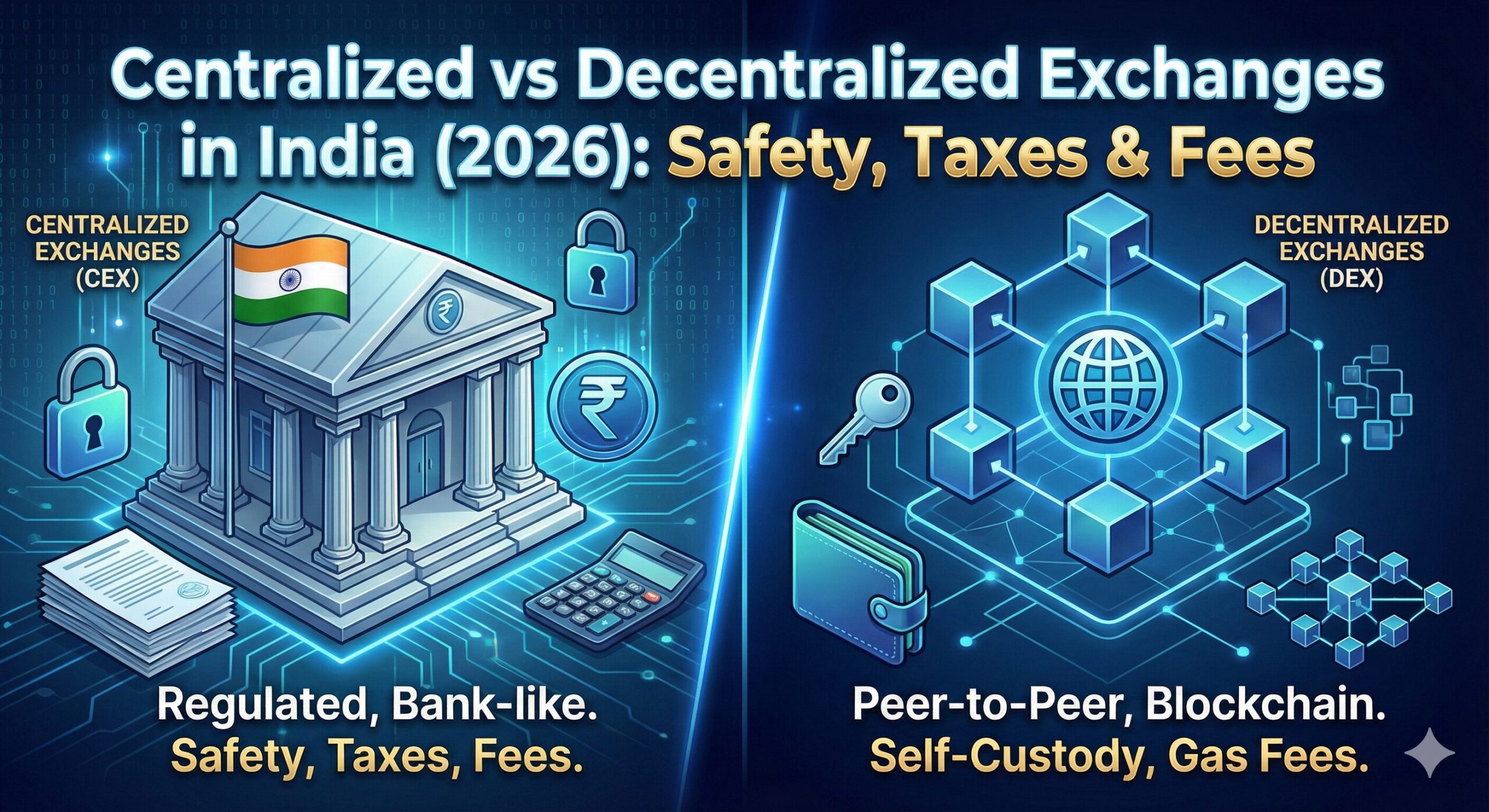
Centralized vs Decentralized Exchanges in India (2026): Safety, Taxes & Fees
If you have been in the Indian crypto groups on Telegram or WhatsApp lately, you have probably seen the debate.
One side says: “Bro, just use Binance or CoinDCX. It is FIU registered and safe.” The other side whispers: “No way. Move your funds to a DEX like Uniswap. No KYC, no tracking, total freedom.”
It is confusing, right? And honestly, a little scary.
With the government tightening the screws in 2026, choosing the wrong path could mean frozen bank accounts or a nasty notice from the Income Tax Department.
So, what is the actual difference for you as an Indian trader? Is it better to stick to the “official” apps, or should you go rogue with a decentralized wallet?
In this guide on Centralized vs Decentralized Exchanges in India, I will break down exactly how they differ in safety, fees, and most importantly—legal risks.
Key Takeaways
- The Main Difference: CEXs (like CoinDCX) are like banks; they hold your money. DEXs (like Uniswap) are like vending machines; you hold your own money.
- Legal Status: Both are legal in India, but CEXs are FIU-registered, while DEXs are currently in a “grey zone” regarding reporting.
- Tax Nightmare: CEXs deduct the 1% TDS automatically. On a DEX, you are responsible for calculating and paying it manually.
- Bank Risk: Buying crypto on a DEX usually requires P2P, which has a higher risk of bank freezes compared to direct CEX deposits.
What is a Centralized Exchange (CEX)?
Think of a Centralized Exchange (CEX) like a stock broker or a bank. Companies like CoinDCX, Mudrex, Binance, and Delta Exchange fall into this category.
There is a company running the show. You create an account, complete your KYC (give them your PAN/Aadhaar), and deposit your INR. They hold your crypto for you. If you lose your password, they can help you reset it.
- Pros: Easy to use, accepts bank transfers (IMPS/UPI), high liquidity, customer support.
- Cons: Not your keys, not your crypto (if they go bankrupt, you might lose funds).
What is a Decentralized Exchange (DEX)?
A Decentralized Exchange (DEX) is just code running on the blockchain. Examples include Uniswap, Jupiter, and PancakeSwap.
There is no company. No CEO. No KYC. You don’t create an “account.” Instead, you connect your personal wallet (like MetaMask or Phantom) and trade directly from it.
- Pros: Total privacy (no KYC), you control your funds 100%, access to rare coins before they list on CEXs.
- Cons: Hard to use for beginners, no customer support, cannot deposit INR directly.
Round 1: Safety & FIU Registration
In 2026, safety isn’t just about hackers; it is about the government.
Centralized Exchanges (CEX): Most major CEXs in India are now registered with the Financial Intelligence Unit (FIU). This means they follow anti-money laundering laws. If you trade here, your bank knows exactly where the money is going. It is “white” money. The risk of your bank account getting frozen is very low because the exchange is a verified entity.
Decentralized Exchanges (DEX): DEXs are not FIU registered. They can’t be, because there is no company to register! While using them is not “illegal,” it raises red flags. Since you cannot deposit INR directly, you usually have to buy USDT via P2P and send it to your wallet. If the P2P seller has tainted funds, your bank account could still get frozen.
Winner: Centralized Exchanges (For peace of mind).
Round 2: The Tax Headache (TDS)
This is where most Indian traders get trapped.
Centralized Exchanges (CEX): When you sell crypto on an Indian CEX (like CoinDCX or Mudrex), they automatically deduct the 1% TDS and deposit it with the government against your PAN card. You don’t have to do anything. It is smooth compliance.
Decentralized Exchanges (DEX): A DEX does not know who you are. It cannot deduct TDS. Does this mean you save tax? NO. It means the burden is on YOU. You are legally required to calculate 1% of every single trade and deposit it to the government yourself using a Form 26QE. If you miss this, you face a penalty equal to the tax amount. It is an accounting nightmare.
Winner: Centralized Exchanges (Unless you love paperwork).
Round 3: Ease of Use & Fees
Centralized Exchanges (CEX):
- Fees: usually 0.1% to 0.2% per trade.
- Ease: Super easy. Download app, click buy.
Decentralized Exchanges (DEX):
- Fees: This depends on the blockchain. On Ethereum (Uniswap), a single trade can cost $5 to $20 in “Gas Fees.” On Solana (Jupiter), it costs less than a penny.
- Ease: Difficult. You need to manage seed phrases, understand “slippage,” and approve smart contracts. One wrong click and your wallet can be drained.
Winner: Centralized Exchanges (For beginners) / DEX (For pro users on Solana/Base).
Comparison Table: CEX vs DEX India
| Feature | Centralized (e.g., CoinDCX) | Decentralized (e.g., Uniswap) |
| KYC Required? | ✅ Yes (Mandatory) | ❌ No |
| Deposit INR? | ✅ Yes (UPI/IMPS) | ❌ No (Crypto only) |
| 1% TDS? | ✅ Auto-Deducted | ⚠️ You must pay manually |
| Custody | Exchange holds funds | You hold funds (Self-Custody) |
| Risk | Exchange Bankruptcy | Smart Contract Bugs / User Error |
| Best For | Investors & Beginners | Privacy Lovers & Experts |
Export to Sheets
Conclusion
So, in the battle of Centralized vs Decentralized Exchanges in India, who wins?
If you earn your salary in INR and just want to invest safely for the future, stick to a Centralized Exchange like CoinDCX, Mudrex, or Delta Exchange. The convenience of automatic tax deduction and direct bank transfers is worth it.
However, if you are a crypto native who understands how to manage keys, pay your own TDS, and wants to trade meme coins on Solana before the world sees them, a DEX is your playground.
Just remember: DeFi does not mean tax-free. The taxman is watching both.
FAQ
Q: Is it illegal to use a DEX in India? A: No, it is not illegal. Using a self-custody wallet and trading on a DEX is allowed. However, you must strictly comply with tax laws (30% tax + 1% TDS) on your own.
Q: Can I avoid TDS by using a DEX? A: No. You are still legally liable to pay it. If the Income Tax department audits your wallet activity (which they can trace), you will face heavy penalties for tax evasion.
Q: Which is the best DEX for Indian users? A: Since gas fees are high on Ethereum, Indian users prefer Jupiter or Raydium (on Solana) because fees are almost zero.
Q: How do I move money from my bank to a DEX? A: You cannot do it directly. You must first buy crypto (like USDT or SOL) on a Centralized Exchange, and then withdraw it to your personal wallet (like MetaMask or Phantom).