Blockchain Technology Explained Simply: A Beginner’s Guide Even a Kid Would Understand
You know, the other day I was sitting at a coffee shop, trying to explain to my younger cousin what I actually do for a living. He’s ten years old, sharp as a tack, but he looked at me like I was speaking alien when I mentioned “decentralized ledgers.”
I paused, took a sip of my cappuccino, and thought, “Okay, how do I explain this without using big, scary tech words?” That conversation sparked this article. If you have ever felt like blockchain is some mystical, complicated math problem that only geniuses can solve, you are not alone. But here is the secret: it’s actually really simple.
I’m going to break down blockchain technology explained simply, so by the time you finish reading this, you could explain it to your grandma—or a ten-year-old.
What is blockchain technology? (The “Magic Notebook” Analogy)
Imagine you and your friends are trading Pokémon cards—or maybe baseball cards, whatever you’re into. Every time you trade a card, you write it down in a notebook so nobody forgets who owns what.
“Alice gave Bob a Charizard.” “Bob gave Charlie a Pikachu.”
Now, normally, one person keeps this notebook. Let’s call him “Dave.” Dave is like the bank. You have to trust Dave to write everything down correctly. But what if Dave loses the notebook? Or what if Dave is having a bad day and decides to erase a line and write that he owns the Charizard now? You would have no way to prove him wrong because he has the only copy.
Blockchain changes the rules.
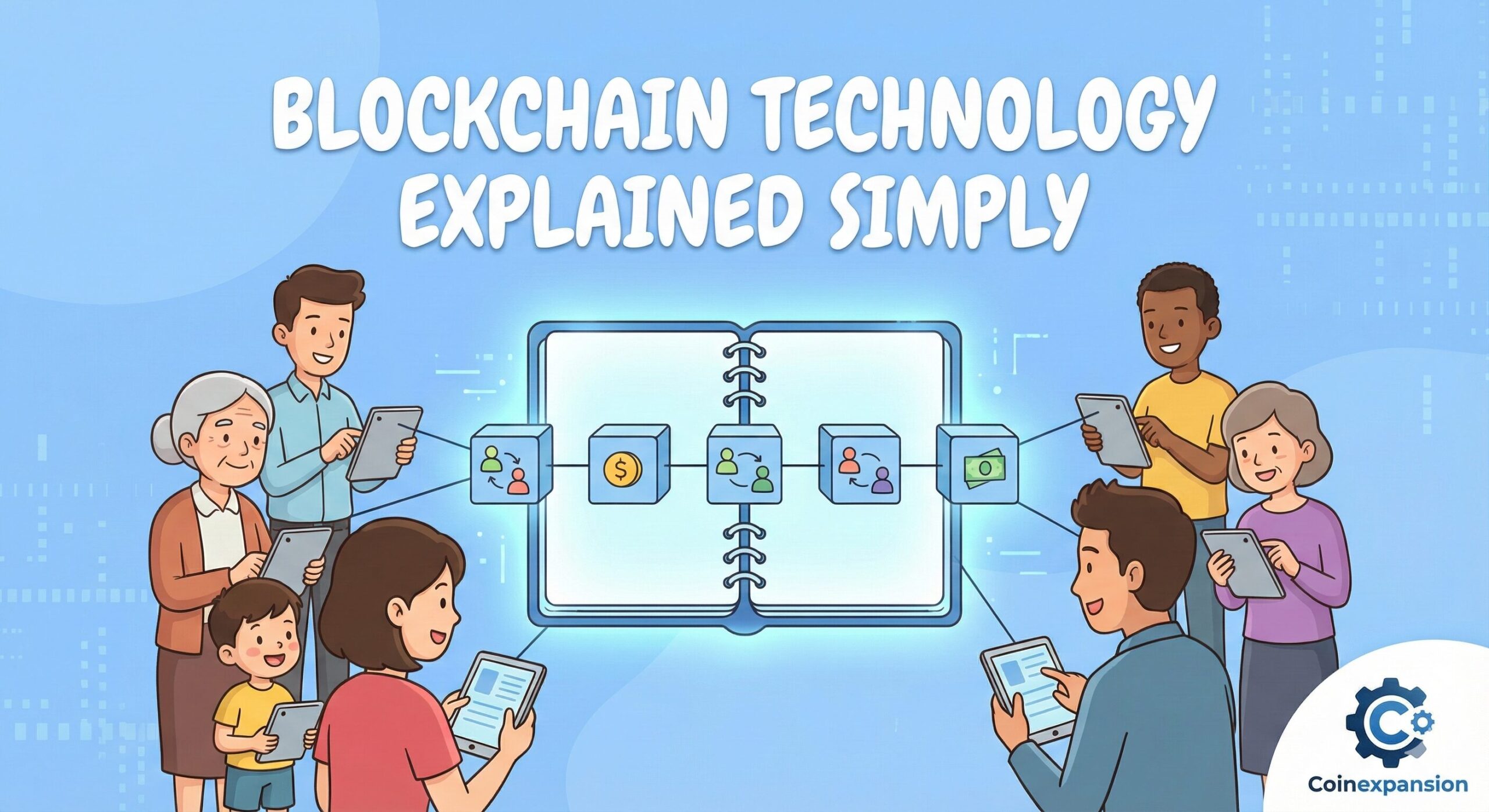
In the blockchain world, everyone in the group gets a copy of the same notebook. Every time a trade happens, everyone rushes to their own notebook and writes it down at the exact same time.
If Dave tries to sneakily erase a line in his notebook, everyone else will look at their own notebooks and say, “Hey Dave! That’s not what we have! You’re lying!” Dave’s change gets rejected, and the truth stays safe.
That is blockchain technology explained simply. It is a shared, digital notebook (ledger) that everyone has a copy of, and nobody can cheat because everyone is watching everyone else.
How Does Blockchain Work? (Step-by-Step)
Okay, so we have the notebook idea down. But how does it actually work on computers? This is where the “Block” and “Chain” parts come in. Don’t worry, I won’t bore you with code.
Think of it like a train.
1. The Transaction ( The Passenger) It all starts when someone wants to send something. Let’s say I want to send you 1 Bitcoin. This request is like a passenger waiting at the station.
2. The Verification (The Ticket Checker) Before the passenger can get on the train, a bunch of computers (we call them “nodes”) check their ticket. They check: Does the sender actually have the money? Is this a real transaction? If the ticket is valid, the passenger is allowed onto the platform.
3. The Block (The Train Car) The passenger (my transaction) doesn’t travel alone. It gets grouped with hundreds of other passengers (other transactions) into a train car. This train car is what we call a Block.
4. The Hash (The Lock) This is the cool part. Once the train car is full of passengers, it gets sealed with a special digital lock called a Hash. This isn’t just any lock. It is a unique code created by all the information inside the car.
If someone tried to break into the car and swap a passenger (change a transaction), the lock’s shape would change completely. Everyone would see the broken lock and know something is wrong.
5. The Chain (The Train) Now, this sealed train car is hooked up to the car before it. This connection is super strong. You cannot remove a car from the middle of the train without unhooking every single car that came after it.
This long line of connected, locked train cars is the Blockchain.
Why Do We Even Need This?
You might be asking, “Why go through all this trouble? Why not just let the bank handle it?” That is a great question. And honestly, for a long time, banks were the best option we had. But blockchain technology explained simply offers a few massive upgrades.
Trust Without Trusting Strangers In the old way, you had to trust the bank manager or the government not to mess up or freeze your money. With blockchain, you don’t have to trust a person. You trust the math. The system works because millions of computers agree on it, not because one guy in a suit says so.
It’s Practically Unhackable Remember the notebook analogy? To hack a blockchain, a hacker would have to change the notebook of every single person in the network at the exact same time. If there are millions of people, that is basically impossible. This makes it way more secure than a central database that has one password.
No Middlemen (And No Extra Fees) When you send money overseas, the bank takes a cut, the receiving bank takes a cut, and the exchange service takes a cut. It’s like buying a ticket and paying three different gatekeepers. Blockchain lets you hand the value directly to the other person. It’s peer-to-peer. Just me and you.
Who Keeping the Books? (Miners and Validators)
You have probably heard the term “Bitcoin Mining” and pictured people with pickaxes digging for digital gold. It’s… kinda like that, but with computers.
Since there is no “Dave” (the bank manager) to write in the notebook, who does the writing?
In a blockchain, special people called Miners compete to do the writing. They use powerful computers to solve really hard math puzzles. These puzzles are the “work” in “Proof of Work.”
Why do they do it? Are they just nice people? Nope! They do it for a reward. The first miner to solve the puzzle and lock the “train car” (Block) gets paid in new cryptocurrency (like Bitcoin).
This system is genius because it makes people want to keep the network safe. If they cheat, they waste electricity and get no reward. If they play by the rules, they make money. It aligns everyone’s selfish interests to create a safe community.
Is Blockchain Only for Bitcoin?
This is the biggest myth out there! People think Blockchain = Bitcoin. But that is like saying The Internet = Email. Email is just one thing you can do on the internet, right?
Bitcoin is just one app that runs on blockchain technology. But you can use this “magic notebook” for so much more.
1. Supply Chains (Tracking Your Sneakers) Have you ever bought a pair of expensive sneakers and worried they were fake? Companies like Nike are starting to use blockchain to track shoes from the factory to your doorstep. You can scan a code and see exactly when and where they were made. Because the blockchain can’t be edited, you know the history is real.
2. Voting Imagine casting your vote from your phone and knowing for a fact that it was counted correctly. No lost ballots, no recounting drama. Because each vote is a transaction on the blockchain, it’s permanent and transparent. Anyone could check the count, but nobody could see who you voted for (thanks to encryption).
3. Digital Art and ownership (NFTs) You know those digital pictures that sell for millions? That uses blockchain too. It proves that you own the original copy of a digital file. It’s like having the deed to a house, but for a JPEG.
The Different Flavors of Blockchain
Not all blockchains are the same. It’s kinda like ice cream—same basic ingredients, but different styles.
Public Blockchains These are the parks of the internet. Anyone can walk in, sit on a bench, and read the newspaper. Bitcoin and Ethereum are public. Anyone can join, download the notebook, and start verifying transactions. It is completely open and transparent.
Private Blockchains These are like country clubs. You need an invite to get in. Companies like Walmart or IBM use these for their internal business. They want the security of blockchain but don’t want the whole world seeing their business secrets. It’s still a shared notebook, but only shared with a select few trusted people.
Key Takeaways
- It’s a Shared Ledger: Think of it as a Google Doc that everyone can view, but nobody can delete.
- Decentralized: No single boss or bank controls it. It runs on millions of computers.
- Immutable: Once something is written down, it’s written in stone. You can’t erase the past.
- Transparent but Private: Everyone can see the transactions, but they can’t necessarily see who made them.
- More than Money: It’s used for tracking food, voting, art, and secure data sharing.
Frequently Asked Questions
Is blockchain the same as cryptocurrency? No. Cryptocurrency (like Bitcoin) is the money that flows on top of the blockchain. Blockchain is the railroad track; cryptocurrency is the train.
Can a blockchain be hacked? Technically, yes, but it is incredibly difficult. A hacker would need to control more than half of all the computers in the network at the same time (called a 51% attack). For big networks like Bitcoin, this would cost billions of dollars and is practically impossible.
Is blockchain bad for the environment? Some blockchains, like the original Bitcoin network, use a lot of electricity because of the “mining” process. However, newer technologies (like “Proof of Stake”) use 99% less energy. The industry is moving toward these greener options very fast.
Who invented blockchain? A mysterious person (or group of people) named Satoshi Nakamoto invented it in 2008 to create Bitcoin. To this day, nobody knows who Satoshi really is!
Do I need to understand the code to use it? Not at all! Do you know how the internet works under the hood? Probably not, but you use it every day. Eventually, blockchain will just be the plumbing running in the background of your apps.